Humans have used colour to create feelings of joy for hundreds of thousands of years. Primitive Neanderthals used it to decorate cave walls, extracting pigments from the ground, and later civilisations developed more complex palettes, as demonstrated by ancient temples and artefacts from Egypt, Rome and Greece.
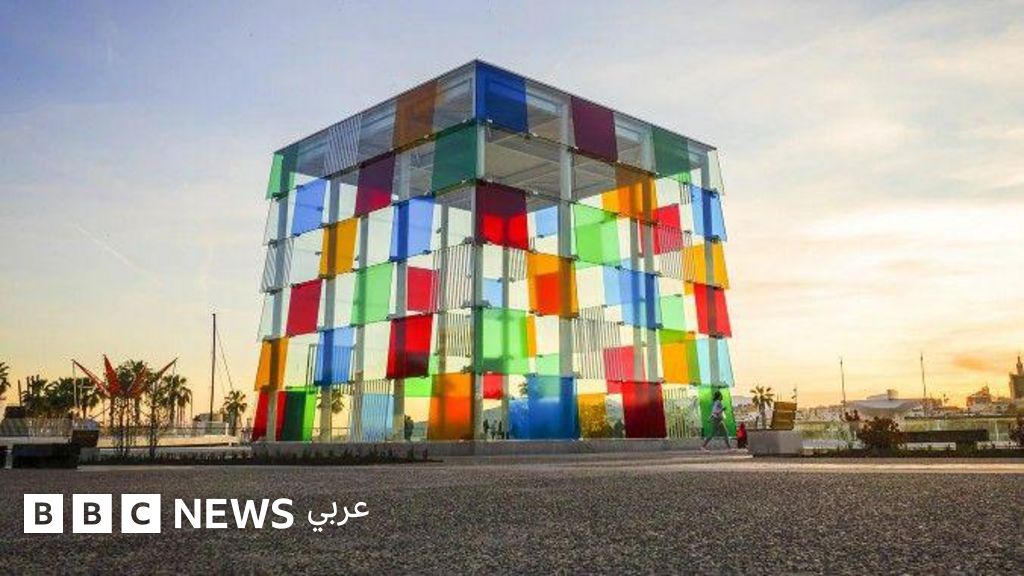
Throughout human history, colour has played a central role in different eras: it was central to the stained glass of medieval churches and to the ceilings and murals of the Italian Renaissance, and it continued to be a fundamental element in building façades during the twentieth century and remains so in the twenty-first. The Málaga Pompidou Centre, a glass cube where light harmonises with colour, designed by artist-architect Daniel Buren, is a prominent example.
Designer Adam Nathaniel Furman and writer Kate Mazade published a new book titled "Chromatic Architecture: The Art of Using Colour in Design", in which they argue that colour is "a critical element for bringing architectural work to heights of fame and delight that would be impossible to achieve without it".
The book by Furman and Mazade highlights eight buildings known for their vibrant colours, as an invitation to architects to use colour more boldly in their projects, as well as an invitation to visitors of these facilities to open their eyes and see what colour can achieve. Among them is the Sri Ranganatha Swami temple in Tamil Nadu, India, which began construction in the first century of the common era and continued for centuries, becoming one of the world's largest religious complexes. The temple extends over more than 150 acres and features 21 three-dimensional doorways known as "gopurams" with bright colours.
Other examples include the Palau de la Música Catalana in Barcelona, built in 1908 as a reflection of Catalonia's identity and prosperity at that time, designed by architect Lluís Domènech i Montaner with influences from modernism, Roman and Gothic architecture, Moroccan decorations and Andalusian styles. Furman sees symbolism in every detail of the hall, as if it had been drawn from an imaginary forest.
The Guardian Building, constructed in 1929 by American architect Wirt S. Rowland in Detroit, is locally known as the "Cathedral of Money" and is one of the world's most outstanding Art Deco skyscrapers. Rowland used colour to symbolise the traditional trades of the Great Lakes area in the early twentieth century. The outer façade is covered with approximately two million bricks and terracotta tiles in orange tones, while the interior features a main atrium with a three-storey vaulted ceiling covered with tiles in primary colours.
The Pirelli Building in Milan, designed in 1969 by Italian architect and artist Gio Ponti, was inspired by the view of regular green fields from an aeroplane window. Despite lacking windows, the building is visually striking. Furman contends that Ponti "transformed a drab concrete façade into a vast field covered in emerald green, into a genuine work of art that belongs to the modern school".
The Helen Keller Building in Japan, a residential apartment complex designed in 2005 in honour of American author and activist Helen Keller, was designed by American and Japanese artists and architects Madeline Ginns and Shusaku Arakawa. The design includes nine apartments that combine cylinders, cubes, spheres and other modern architectural forms with vibrant colours. The designers intended to stimulate residents emotionally through colour, assuming that "if the environment succeeds in stimulating people to break out of the monotony of their daily lives, it can extend their lives".
The Maishima Transfer Station in Japan was designed by Austrian artist and architect Friedensreich Hundertwasser, though he died in 2000 before the project was completed. Hundertwasser was a rebel against the flat surfaces of modernism and advocated for viewing architecture as a living being in constant evolution. The station features yellow stripes as if painted by hand hanging from top to bottom of the building, a cylindrical tower with red lines, short supports covered with various vibrant colours, a waste plant chimney painted in watercolours, walls with a chessboard pattern, yellow lines like sunflower flowers and other red ones.
The Public Library and Municipal Archive of Torrejón de Ardoz, built in 2019, was designed by the Madrid-based firm BN Asociados Arquitectos.