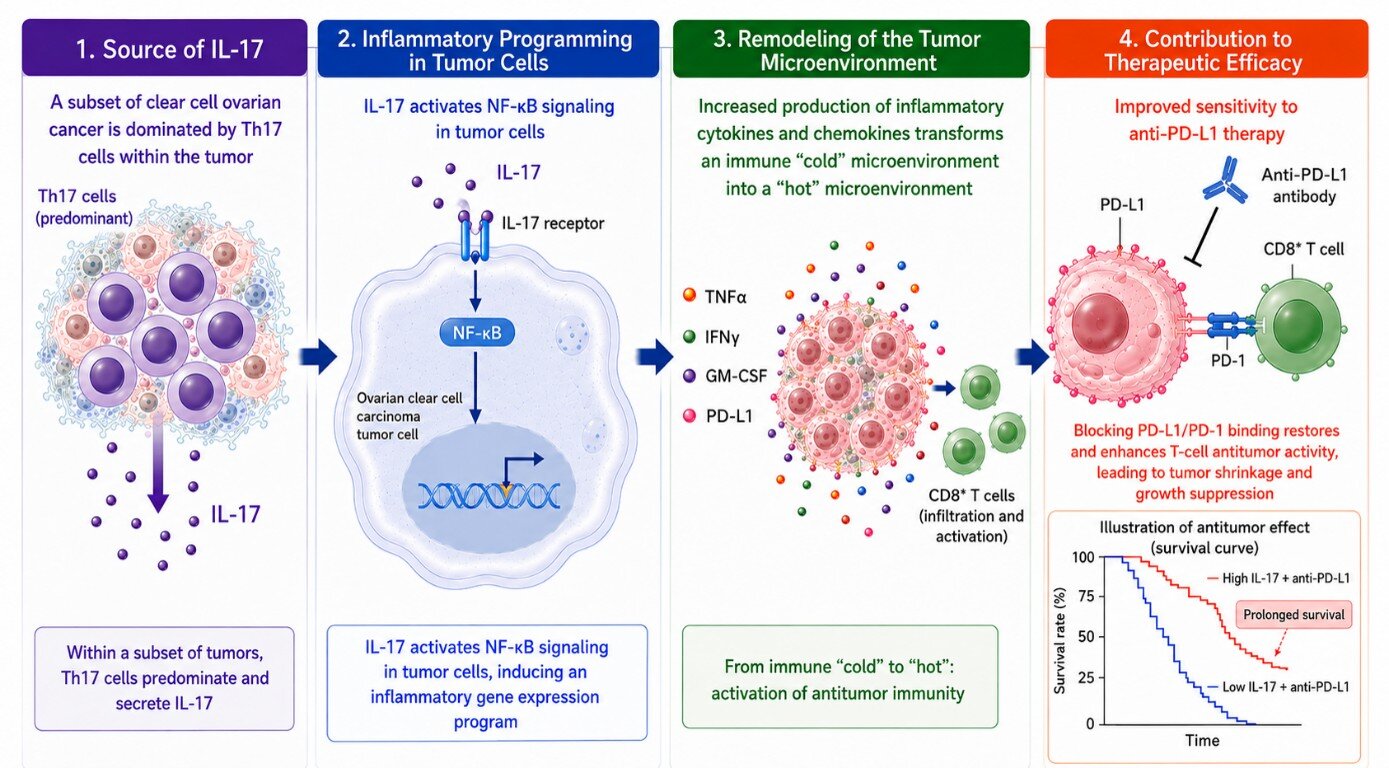
A research group revealed through studies in humans and mice that a subset of clear cell ovarian cancers, considered difficult to treat with anticancer drugs and immunotherapy, responds to immunotherapy. The researchers also identified the IL-17 protein, related to inflammation, as a key factor underlying this response.
The study found that IL-17 acts directly on cancer cells and creates a tumour microenvironment permissive to immunity by recruiting immune cells. The work was published in the journal Molecular Cancer and was led by Kosuke Murakami, instructor at the Department of Obstetrics and Gynaecology at Kindai University School of Medicine in Sakai, Osaka Prefecture, and professor Noriomi Matsumura, head of the department, along with collaborators including Shiki Takamura, director of the Immunological Memory Laboratory team at the RIKEN Centre for Integrative Medical Sciences in Wako, Saitama Prefecture.
Ovarian cancer is one of the most difficult gynaecological cancers to treat. Clear cell ovarian cancer represents approximately one quarter of all ovarian cancers in Japan and is more common there than in Western countries. Because it is resistant to anticancer drugs and remains difficult to manage after recurrence, new treatment strategies have been urgently needed.
In recent years, cancer immunotherapy, which harnesses the body's immune system to attack cancer, has shown promising results in treating various types of cancer. However, large-scale clinical trials have not demonstrated clear clinical benefit in ovarian cancer. Clear cell ovarian cancer has long been considered an immunologically cold tumour because it contains few surrounding immune cells.
The research group first analysed tissue samples and genetic data from 180 cases of clear cell ovarian cancer in humans. The results revealed that, although the overall number of immune cells is low, a very small proportion, approximately 5%, exhibits a subtype in which the IL-17 protein is highly active. This type of cancer showed an inflammatory signature characterised by infiltration and activation of immune cells within the tumour microenvironment, a characteristic that emerged independently of markers traditionally used to predict immunotherapy efficacy.
Second, the researchers verified the mechanism by which IL-17 acts using a mouse model that replicates clear cell ovarian cancer and cultured cells. The results revealed that IL-17 acts directly on cancer cells, activating the inflammatory switch known as NF-κB within the cells and causing them to release substances that attract and activate immune cells. When an environment conducive to IL-17 action was established in mice, increased infiltration and activation of immune cells within tumours was observed, leading to improved immunotherapy efficacy and prolonged survival.
The findings indicate that IL-17 acts as a trigger that transforms immunologically cold tumours into a state in which the immune system can effectively attack cancer cells. Identifying tumours with high IL-17 activity may provide a new biomarker for selecting clear cell ovarian cancer patients likely to benefit from immunotherapy. These results suggest that the response to immunotherapy does not depend on common biomarkers such as microsatellite instability or high tumour mutational burden.
The findings provide new insights that can be applied not only to clear cell ovarian cancer but also to a wide range of cancer types, suggesting that the inflammatory environment created by the cancer cells themselves influences immunotherapy efficacy. According to Murakami, "although it represents only a small subset, we have demonstrated that there are types of cancer that are highly sensitive to immunotherapy, which opens new possibilities for personalised treatment".