Alma Ronén, a soldier in the Israeli army, changed out of her uniform, put on jeans and a t-shirt, and headed to a café in Jerusalem for a relaxed Saturday. But almost every week over the past few months, ultra-Orthodox Jews have tried to dissuade her and other customers from entering.
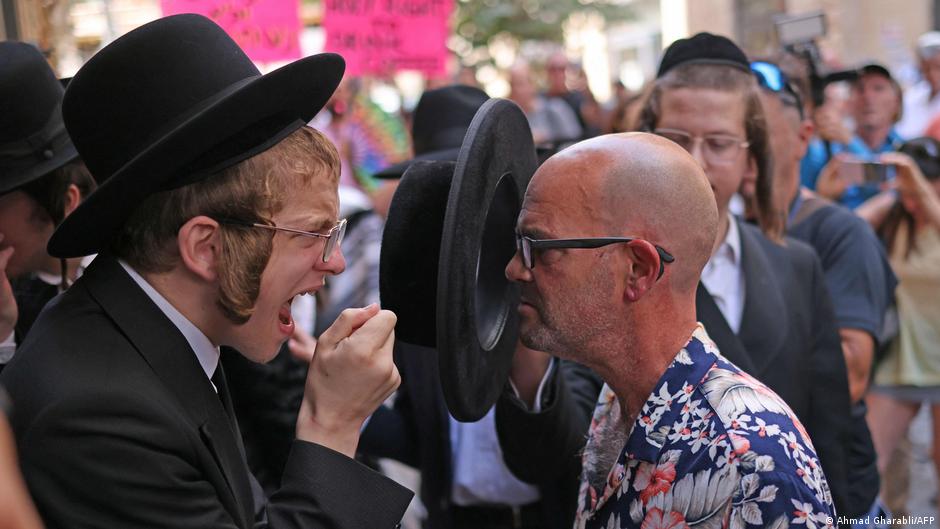
Outside the Basimta café, located near an ultra-Orthodox neighbourhood, dozens of men and teenagers dressed in black shout "Shabat", the Jewish holy day. On the other side, secular activists with pink signs blow whistles to drown out the shouts of their opponents. One of the signs reads "Our sacred right to drink coffee".
The café has become a flashpoint over the past two months between secular Jews and ultra-Orthodox Jews who are demanding its closure during Shabbat, the weekly day of rest that runs from Friday night to Saturday night. During this time, Jewish law prohibits work, driving, switching electricity on or off.
Adele Ben David and her husband Yoel Ben David run the café as part of an organisation called "Jews for Jesus", which combines Jewish identity with Christian faith in Jesus as the messiah. Ben David told German media that the confrontations represent a burden every weekend but that they are determined not to give up. "If we close now, the ultra-Orthodox will know they can close every place later", he said.
Laura Wartón, a secular protester, sees the conflict over the café as a symbol of a broader social struggle over how much control religious groups should exercise over Israeli public life. "We want a government committed to liberal values and basic democracies", Wartón said.
Aya Lifkovich, from the "Pink Front" organisation who travelled from Tel Aviv to defend the café, argues that every Israeli must have the freedom to choose whether to observe Shabbat or not. "Each person should be able to rest as they wish, and a small minority backed by the government should not impose their behaviour on them", she said.
For his part, an ultra-Orthodox Jew confronted the protesters saying that he did not want his children to see a café open during Shabbat. "It is not that I do not respect you, but this affects my family's faith. When you say you are Jewish, that means a commitment", he added.
The ultra-Orthodox protesters refused to comment with reporters, saying that speaking violated the rules of Shabbat.
Ronén, who served in the army in Gaza and southern Lebanon, expressed frustration over another issue dividing the country: the exemption from military service for ultra-Orthodox Jews, who also receive grants for religious studies. "I feel a deep anger at the idea of forcing only a certain group to fulfil military service", she said.
The issue of mandatory service has gained sensitivity in recent years, as the Israeli army needs more soldiers with the multiple armed conflicts it faces. It has become a central axis of the electoral campaign ahead of the 27 October legislative elections, with rivals of Prime Minister Benjamin Netanyahu promising to end exemptions for the ultra-Orthodox.
Netanyahu has relied on the political support of ultra-Orthodox Jews for nearly two decades and has allowed this sector to expand its influence under his government, currently the most right-wing in Israeli history.
According to a study published last year by the Jewish People Policy Institute, 53% of Israelis consider themselves completely or partially secular. However, the 2023 attack, the deadliest in the country's history, has pushed more Israelis towards religiosity.
But according to Shlomit Ravitsky Tur Paz, director of the "Religion and State" programme at the Israel Democracy Institute, society has gradually become more secular, with more services available during Shabbat. However, she noted that religious Jews represent a growing proportion of the population due to higher birth rates among the ultra-Orthodox, who now constitute 14.3% of the population, according to the Israeli Studies Institute.