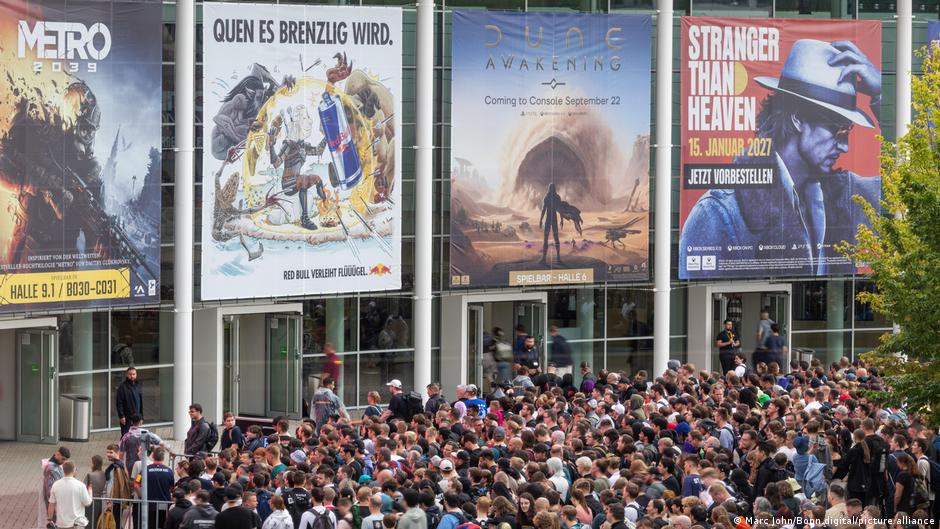
Gamescom 2026, held in Cologne from 26 to 30 August, closed as the world's most important event dedicated to video games, bringing together 1,700 exhibitors from 67 countries—70% of them non-German—across 233,000 square metres. It was the first time the event had reached full capacity. German President Frank-Walter Steinmeier attended on 27 August, marking the first visit by a serving German president to the fair.
The 2026 edition emphasised the cultural role of video games in the face of mounting industry challenges: high development costs, slowdown in attracting new users and the economic impact of artificial intelligence. Steinmeier stated that digital games are "a matter of cultural importance, and therefore also important for our democracy", highlighting their potential to manage stress, reduce loneliness, develop cognitive skills and promote civic education. However, he warned of the need to explicitly address risks such as addiction, violence, racism, sexual discrimination and extremism.
Artificial intelligence dominated technical discussions. The technology can reduce time spent on repetitive tasks and allow small studios to achieve what previously required larger teams. Nevertheless, according to a Quantic Foundry survey, 85% of respondents held negative or below-neutral positions towards generative artificial intelligence in gaming. Rising demand for memory chips and data centres has raised the price of computer components, making gaming equipment more expensive at a time when prices have historically fallen.
Saudi Arabia staged the most prominent participation from the Arab world. MBC Game Studio unveiled its first game at the opening ceremony: "1001 Threads of Mizan", an action and fantasy adventure inspired by stories from "One Thousand and One Nights" that combines exploration, large-scale combat and cooperative gameplay for three players. The game, which runs on PlayStation 5, Xbox Series X/S, Nintendo Switch 2 and PC platforms, features a flying carpet that allows both aerial and ground movement to face mythological creatures. Experts view the launch as evidence of a shift in Saudi capital from financing assets and acquisitions towards building studios and developing new intellectual property. This strategy was reinforced by the Saudi Public Investment Fund's approval in July to acquire Electronic Arts for 55 billion dollars.
Qatar presented a "Qatar Pavilion" coordinated by Invest Qatar and Media City Qatar, occupied by six Qatari companies involved in game development, distribution and mobile gaming. The approach sought to position Doha as a regional hub for game development and digital content, addressing a linguistic and cultural gap: more than 400 million Arabic speakers represent a vast market with limited game content on global platforms. According to Qatar Media City, some participating companies exceeded 10 million global downloads. The meetings brought entrepreneurs together with distributors, investors and technology providers in search of funding, distribution and long-term collaborations.
Morocco recorded its first official participation through a national pavilion of 102 square metres led by AMDIE with support from the Ministry of Youth, Culture and Communication. The contingent included 11 Moroccan video game development studios. Rashed El-Ansari, technical director of a Moroccan studio, explained that while emerging Moroccan companies seek funding mainly in France, the Moroccan government has begun to support the sector through incubators. AMDIE projects that Morocco will become Africa's centre for video game production by 2032. Eight of the participating studios were selected from an incubator launched by the ministry with the French embassy, while three won awards in the "Early Exclusive Showcase" category at Morocco Gaming Expo 2026.
Gamescom 2026 significantly expanded the independent gaming zone, which hosted more than 420 companies—a 16% increase from the previous year. According to data from the German industry association, around 17 million gamers in Germany prefer independent games, valuing them especially for creativity in gameplay mechanics, storytelling and visual identity. Visitors expressed a preference for cooperative games with clear cultural identity over content generated entirely by artificial intelligence. The developers' conference featured more than 380 speakers in 230 sessions spread across 18 platforms, while events such as Invest Circle connected developers, investors and distributors. Although official attendance figures have yet to be published, projections suggest a possible surpassing of the 2025 record of 357,000 visitors from 128 countries.