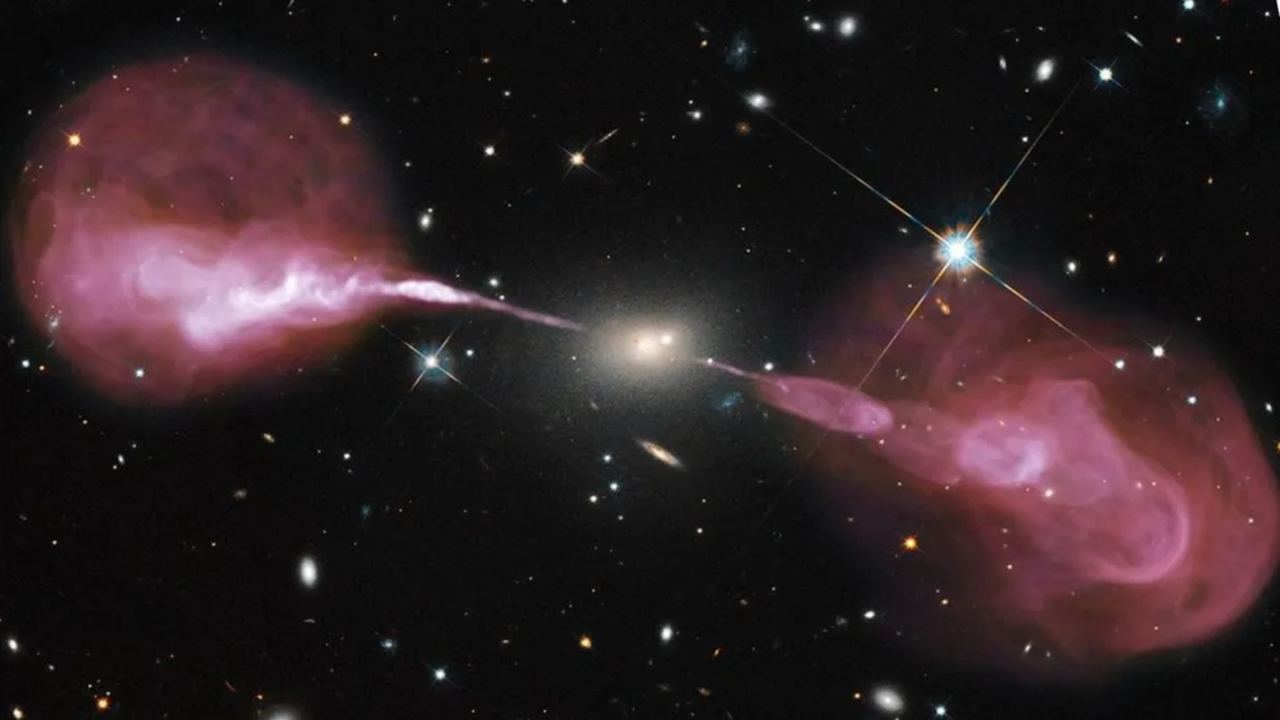
Astronomers discovered a population of so-called "radio galaxies" with "fading radio lobes", revealing what happens when the supermassive black hole engines that drive these enormous plasma jets shut off. The discovery increases understanding of the life cycles of galaxies.
The research team studied 14 candidates for faded or remnant radio galaxies found in a region of sky intensively studied by the XMM-Newton X-ray spacecraft, called the XMM–Newton Large-Scale Structure (XMM–LSS) field.
Radio galaxies are extremely bright in radio waves and possess vast lobes of gas that can extend millions of light years. Remnant radio galaxies represent the final stage in the evolution of radio galaxies, in which jets from the central regions of galaxies, or active galactic nuclei (AGN) powered by growing supermassive black holes, have switched off. Therefore, these jets can no longer replenish the vast radio lobes, causing them to fade gradually.
The researchers studied the XMM–LSS field using the MeerKAT radio telescope, an array of 64 antennas located in the desert region of the Northern Cape, South Africa, the Jansky Very Large Array and the LOFAR (Low-Frequency Array) network. This powerful combination of observations allowed them to study how radio emissions from the lobes of radio galaxies change as particles in them "age" and lose energy.
The researchers determined that 12 of the 14 candidates are indeed remnant radio galaxies, while the other two remain active radio galaxies. The team also discovered something remarkable about the 12 confirmed radio galaxy remnants: their ages showed that they had been fading for between 8 million and 42 million years, with an average "fading age" of 12 million years. This age is lower than the ages measured for other radio galaxy remnants, which could indicate that astronomers have been overlooking a population of short-lived remnants.
The findings also revealed that the studied remnants exist across a wide range of evolutionary stages, with some having jets that have only just switched off, while others are more evolved, having been "turned off" a long time ago. The new results represent an important advance in understanding the life cycles of radio galaxies and how supermassive black holes function as engines that drive the jets that generate the vast radio lobes. The team's research was published on 14 July in Monthly Notices of the Royal Astronomical Society.