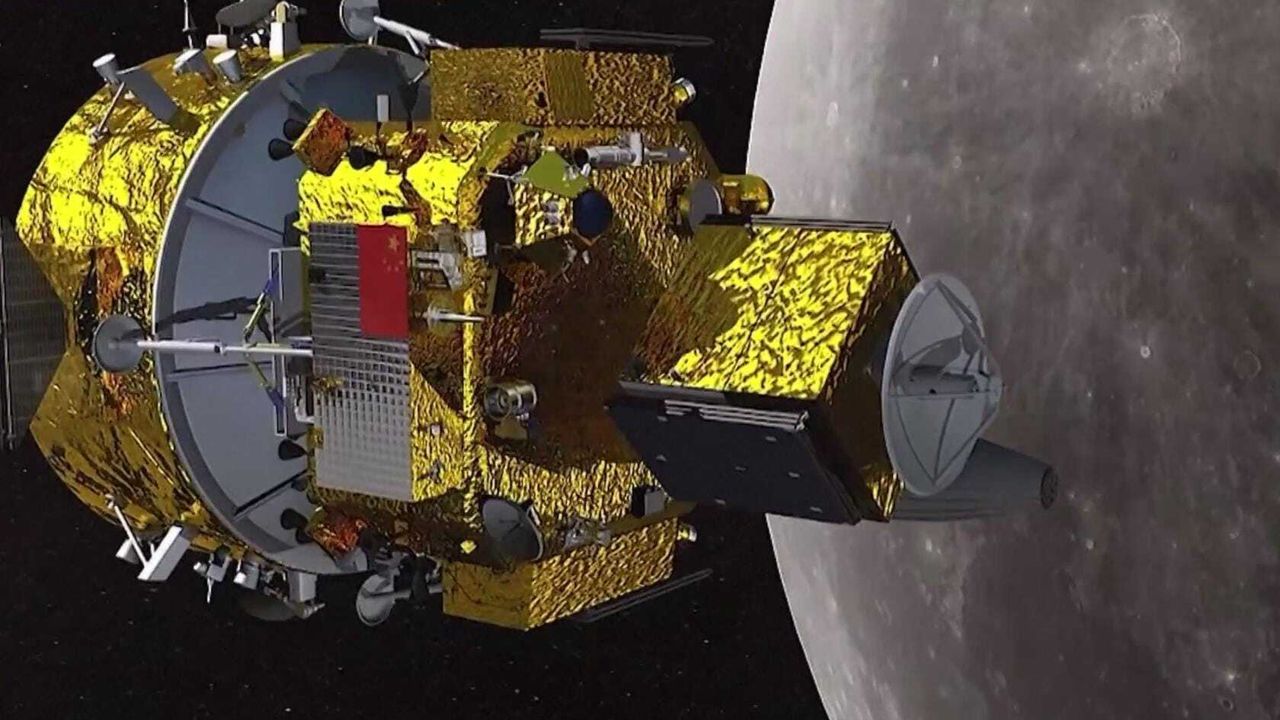
China's lunar exploration programme is preparing to carry out an ambitious robotic mission comprising an orbital satellite, a landing module, a rover, a hopper and a wide range of international experiments, including instruments supported by the United States.
The Chang'e 7 hardware was transported to the Wenchang launch site in April of this year, with a launch scheduled for 24 August (Beijing time) aboard a Long March 5 Y14 rocket. The destination of the landing module is the edge of the Shackleton crater in the lunar south pole region.
Following the launch, the Chang'e 7 orbital satellite will remain in lunar orbit for several months before releasing its landing module for an attempted descent toward the end of the year. While Chang'e 7 will carry out ambitious and pioneering lunar science, it will also lay the groundwork for China's first crewed lunar landing on the lunar surface in 2030, according to authorities.
James Head, a prominent lunar scientist at the Department of Geological Sciences at Brown University in Providence, Rhode Island, stated that the upcoming Chinese lunar launch will set a new benchmark for lunar science missions. "Chang'e 7 is the most ambitious, complete and complex robotic lunar mission ever attempted by any nation or entity," Head told Space.com.
Zhang Jingbo, spokesman for China's Manned Space Agency (CMSA), said earlier in the year that the mission "will fully leverage the technological experience and practical expertise accumulated over decades" to "strive without sparing efforts to achieve the objective of China's first lunar landing in 2030".
Once released from the Chang'e 7 landing module, the hopper is scheduled to "hop" from illuminated areas to shadowed craters in search of water ice deposits. The hopper uses active damping technology to land safely on slopes. The landing module will also deploy China's first "reference image navigation" system in deep space.
While scientists around the world believe there is water ice on the moon, none has found or fully evaluated it, according to Ye Peijian, a scholar from the Chinese Academy of Sciences. "Now China is going to look for it [...] and we are using many methods, from searching on the surface to exploring inside craters," Ye told China Central Television (CCTV).
The Chang'e 7 mission will adopt an integrated exploration approach, combining orbit, landing, rover exploration and hopping, to investigate the environment and resources of the lunar south pole, while also carrying out international cooperation, CCTV reported. Likewise, a Chang'e 8 mission is planned for around 2028, designed to test technologies for building habitats using lunar soil.
Together, the two robotic projects—Chang'e 7 and Chang'e 8—have been tasked with helping to orchestrate China's planned and multi-phase International Lunar Research Station (ILRS).
The Chang'e 7 mission hardware is equipped with a variety of instruments from other nations and organisations. The ILO-C instrument from ILOA Hawaii and the University of Hong Kong's Space Research Laboratory will be housed directly in the Chang'e 7 lunar landing module, destined for the illuminated edge of the Shackleton crater.
"The HKU Space Research Laboratory is proud to partner with ILOA for this historic lunar mission and look forward to working with them to maximise the scientific performance that this exceptional wide-field optical camera will deliver," said Quentin Parker, Emeritus Professor at the University of Hong Kong.
Through visible colour imagery, the ILO-C camera project aims to spark public interest in lunar exploration, astronomy and space sciences, thereby laying a social foundation for future lunar science missions, Parker said. Operating in the extreme lunar environment, the compact camera will perform the first colour astronomical imaging from the moon, according to Elisa Perednia, President and Chairman of ILOA. The camera is designed to capture unprecedented full-colour wide-field images of the Milky Way galactic plane from a stable observation point based on the moon, she added.
The Beijing Institute of Space Mechanics and Electrical Engineering (BISME) built the camera according to the specifications of the ILO-C instrument team. A sad note: the camera aboard the Chinese lunar landing module was pioneered by ILOA's founding director Steve Durst, who passed away earlier this year. He was a visionary leader who worked with representatives of the Chinese aerospace industry since the nineteen-eighties. "We are proud to have joined the mission and to help realise Steve's wonderful vision," Parker of HKU-LSR told Space.com.