The Curiosity rover team celebrated this week the fourteenth anniversary of its landing on Mars. Curiosity left Earth on 26 November 2011 and landed on Mars on 6 August 2012. During the week marking the transition from Martian year 14 to year 15, the rover continued its routine scientific operations while scientists on Earth exchanged memories and reflected on the accumulated discoveries.
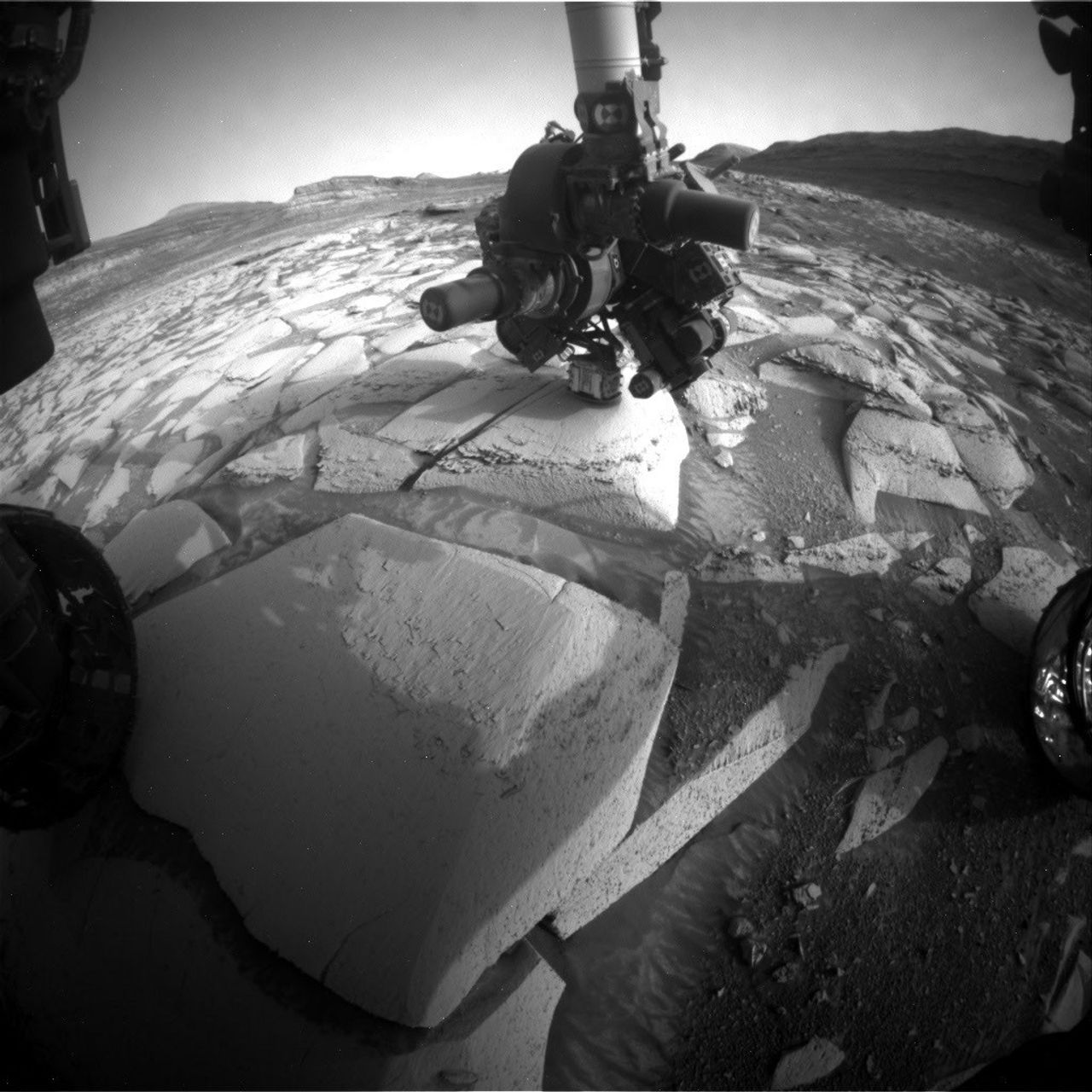
At the moment of the anniversary, specifically Sol 4976 at 19:47 Martian local time, the rover's arm was deployed taking a measurement with the APXS instrument on the target "Tunas Khasa". The rover continued its ascent of Mount Sharp investigating different rock layers along the way. At one point during the previous Friday, the rover's incline was 24 degrees, though engineers confirmed they successfully managed the situation and reached the planned location.
At the week's first stop, the APXS measured "Tunas Khasa" and "Villarrica", which were also photographed with the Mars Hand Lens Imager (MAHLI) instrument. The ChemCam instrument investigated the targets "Lago Rupanco" and "Chulipa Punta", acquiring high-resolution images of targets of interest as well. Scientists were specifically looking for cross-stratification structures, which describe rock layers that tilt and intersect with one another, to understand how the different rock layers relate to each other.
A displacement of 46 feet (14 metres) positioned the rover in front of a special location where two different rock layers meet and where cross-stratified rocks are truncated by other layers. The team planned to remain at this location for two planning cycles due to the exceptional scientific interest of the site. APXS analyses focused on "Salar de Gorbea" and "Uriondo", while MAHLI documented these targets and included a particularly extensive mosaic of the "Tres Morros" target, which exemplifies how the different rock layers meet exactly.
Both week's plans included abundant environmental monitoring, with multiple surveys of dust devils, measurements of atmospheric opacity and wind monitoring. The team also searched for clouds and the RAD instrument continued actively measuring the radiation environment, a function it has performed continuously during the mission's 14 years.