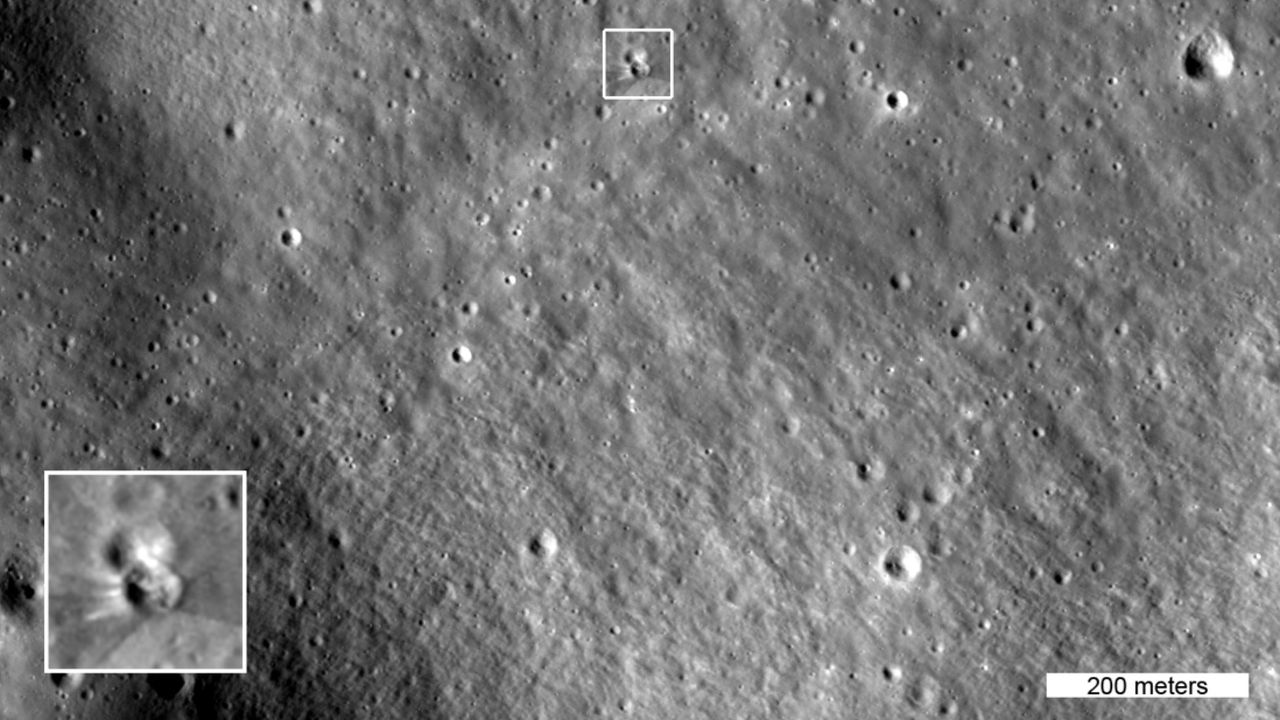
NASA's Lunar Reconnaissance Orbiter (LRO) spacecraft captured images of the impact site of an upper stage of SpaceX's Falcon 9 rocket. The photographs were taken on 11 and 12 August, days after the rocket body crashed into the moon near the Einstein crater at 8,690 kilometres per hour.
The LRO's high-resolution camera system, known as LROC, obtained clear views of the impact site from several angles, photographing every 117 minutes, the time it takes the orbiter to complete one orbit around the moon. According to Mark Robinson, principal investigator for LROC based at Intuitive Machines in Houston, the new crater measures approximately 18 metres wide and appears to be less than 3 metres deep.
"The distinctive V-shaped ejection pattern on the south side of the crater is consistent with natural impactors hitting the moon at low angles to the surface," Robinson said. The sixth and final image in the sequence of the new crater was captured at the highest slew angle (68 degrees), presenting a view similar to what an Artemis astronaut would see looking towards the lunar horizon from the window of his Orion spacecraft.
According to NASA, the LRO images show bright and dark rays extending from the crater. NASA officials noted in a statement on 18 August that the dark streaks are composed of surface dust and rocks altered over time by solar wind, galactic cosmic rays and micrometeorite impacts. This weathered material was excavated by the collision, while the brighter streaks near the crater rim were formed by "fresh material excavated from deeper underground".
The site of the 5 August crash was previously photographed by South Korea's Lunar Pathfinder Orbiter, also known as Danuri. The mission team used Danuri's high-resolution Lunar Terrain Imager to locate the new crater. After capturing images of the impact zone, the Danuri mission sent updated crater coordinates to the LRO team to help refine its follow-up imaging sequence, NASA officials indicated.