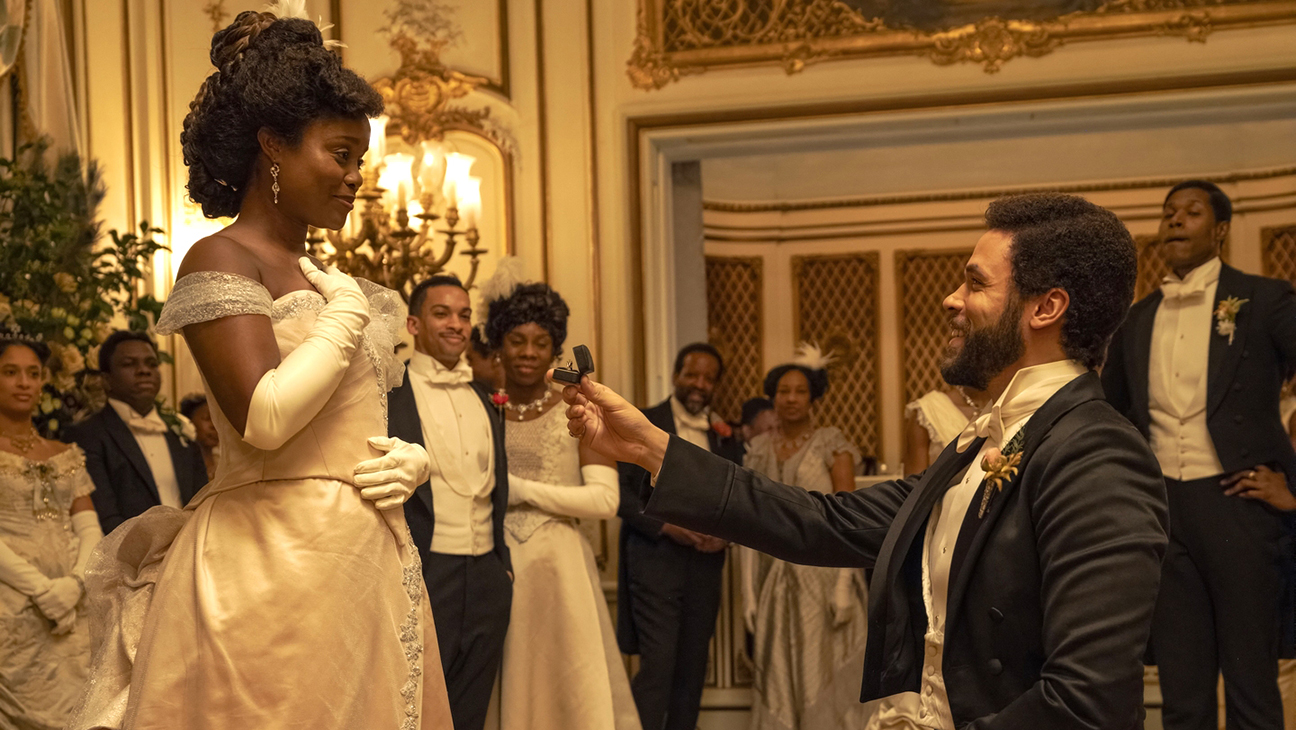
When Salli Richardson-Whitfield learned that the season finale of the third season of The Gilded Age would end with a marriage proposal at the Negros' Ball, she immediately claimed the director's chair for the episode. Richardson-Whitfield, who is also an executive producer on the series, recalled saying: "No, nobody else is going to direct that".
The director, who made history in 2024 as the first Black woman to receive an Emmy nomination for directing a drama — Winning Time: The Rise of the Lakers Dynasty — was also set to direct the finale of another HBO series, Task. However, she ended up directing the penultimate episode of the first season, in which Tom Pelphrey's character Robbie is killed during an FBI operation, citing her love for action sequences. "In your mind, you always think the finale is the important one, and many times it's the episode just before the finale that carries all the weight," Richardson-Whitfield said.
Her work on the Task episode and the finale of The Gilded Age led Richardson-Whitfield to make history once again at the Emmys, becoming the first Black woman to receive directing nominations in two drama series. "It's insane for me," said the former actress about her trajectory behind the camera. "But I take it very seriously. That's why I work so hard".
Richardson-Whitfield described how she coordinated the dance scene in The Gilded Age finale, where guests dance while Dr. William Kirkland, played by Jordan Donica, crosses the room to propose marriage to Peggy. She explained that she wanted the proposal to feel like every girl's fantasy, inspired by stories like Cinderella and the romance of old movies. She noted that she used a slow-motion shot focused on Peggy's face from William's perspective, wanting her face to look angelic and beautiful. She said that actress Denée Benton and the writers were in tears watching it on the monitor.
Richardson-Whitfield said she wanted both dances — Bertha's and the Negros' Ball — to feel equally important in the narrative. She explained that although Bertha and George have billions of dollars today, that did not mean the ball of the Black elite could not be equally magnificent. She noted that she designed both scenes to cut without clear transitions, so viewers sometimes would not know which ball they were watching until fully immersed. "That required a lot of planning, storyboarding and special shots," she said.
Regarding the episode's themes, Richardson-Whitfield explained that the episode is very women-focused and shows that "we can make mistakes and we can be forgiven and we don't need to be ashamed of them for the rest of our lives". She highlighted that in the 1880s, women were beginning to have more voice in society, a change reflected in both Peggy's and Bertha's characters.
When asked about the biggest challenge when directing each series, Richardson-Whitfield responded that although there are big scenes, she always tries to ensure that the central story is not lost from sight. "If it's just a fight scene, who cares? If it's just people dancing at a ball, who cares?" she asked. She used the example from the Task episode where Robbie is stabbed in the forest: "It's not just a fight scene. It's two men who hate each other, face to face". She explained that what makes that fight scene excellent is the feeling of empathy towards both characters and what they are experiencing.
As for the final scene of the episode where Robbie floats peacefully in the water, Richardson-Whitfield explained that they wanted to bring back the essence of the story: Robbie, who is an imperfect but good man who was placed in difficult circumstances. "His family is the most important thing to him, and the guy had the biggest heart in the world," she said. "That's what we brought back at the end, not all the bad decisions".
Richardson-Whitfield noted that she never imagined that her Emmy nominations would mean so much to other people when she made the transition from actress to director. "I started as an actress. I thought I would be there receiving my little Emmy for acting," she recalled. She said that now she is realising that this means much more to others. "Never in my wildest dreams did I think I would be a role model and that people would be looking to me with the hope of achieving what I have achieved".
Richardson-Whitfield expressed her concern about not failing through lack of hard work or effort, and noted that it is important for the young women coming after her who want to be filmmakers. "Sometimes people don't think that women directors can make action films. I have proved that we can. Maybe we do it differently, but maybe that's better," she concluded.