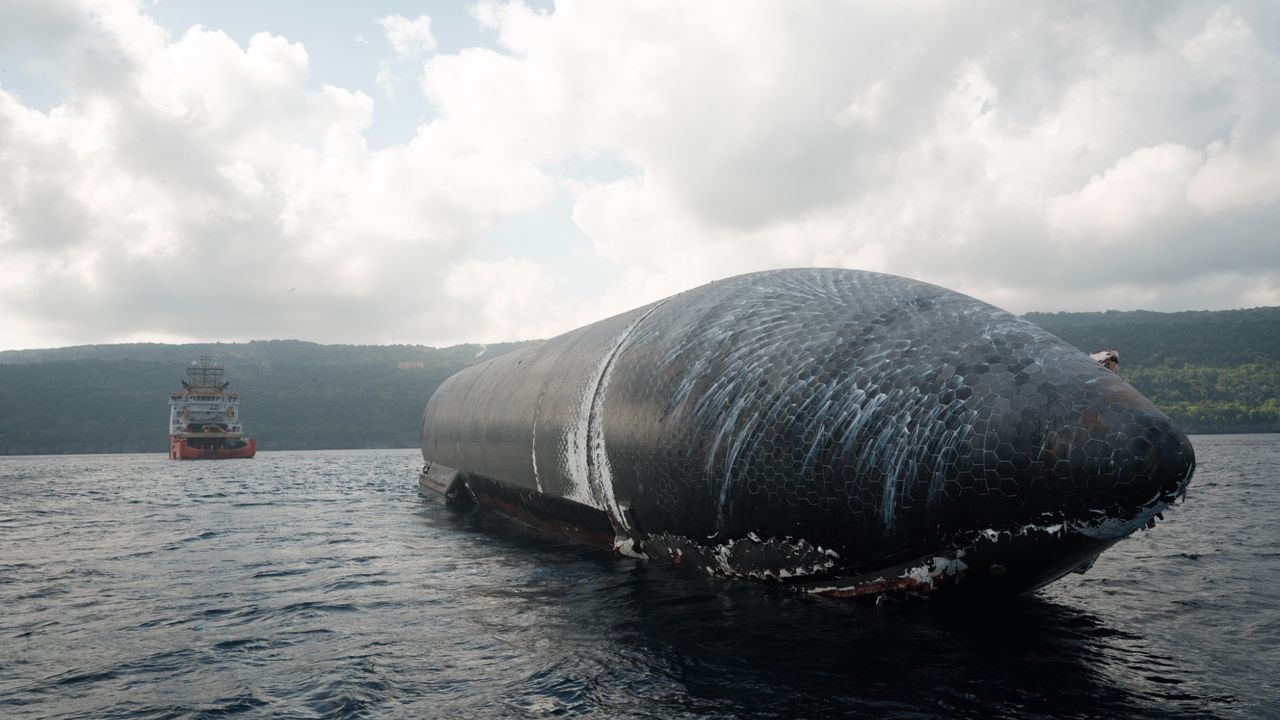
The ocean has been benevolent, or at least more so than expected, with SpaceX's Starship, which has been towed across the Indian Ocean towards calmer waters. Ship 40, the upper stage that flew on Starship's Flight 13 test launch, made the first successful and intact ocean landing of the vehicle at the end of its mission on 24 July, after lifting off from SpaceX's Starbase facility in south Texas. The ship landed in the Indian Ocean as planned and has since become the focus of SpaceX's recovery team, tasked with towing it to port.
Over the past 24 days, that team faced "challenging conditions and increasingly rough seas", SpaceX said in a post on 7 August on X, and at one point success in bringing Ship 40 to dry land safely was not expected. Despite the obstacles, they have now reached calmer waters. The massive vessel, 171 feet tall (52 metres), now floats just off Christmas Island's shores, awaiting inspection. "A team of SpaceX engineers is en route to conduct further analysis on the ship in calmer waters before attempting to return it to Starbase", the company said in an update on 18 August.
Christmas Island is an Australian territory located approximately 1,200 miles (1,900 kilometres) north-west of Broome. Most of the island is a national park, and it is famous for its approximately 40 million red land crabs, which migrate in mass towards the sea to spawn in one of the world's great wildlife spectacles.
Flight 13 was the second launch of the design Version 3 (V3) of SpaceX's colossal Starship rocket. The V3 debut on Flight 12 in May did not go exactly as planned: engine issues after stage separation caused the vehicle's Super Heavy booster to crash into the Gulf of Mexico rather than landing gently as intended. Ship 39 executed its landing burn over the Indian Ocean just as Ship 40 did, but Ship 39 exploded after hitting the water, the expected outcome for Ship stages in Starship test flights. Ship 40 was the first to survive the ocean landing intact.
The fact that Ship 40 did not explode has given SpaceX an unexpected opportunity to study the ship up close. The company's iterative design process has led to the introduction of incremental improvements for each successive Starship launch. Ship 40 is the first upper stage to have flown into space and returned in one piece, and therefore provides a previously unstudied item for evaluation as SpaceX works to refine the ship's aerodynamics, hydraulics, thermal tile efficiency and overall design.
Starship is SpaceX's super-heavy lift launch vehicle, designed to be the world's most powerful rocket and the first capable of full reusability. Starship's expected operational availability has been a moving target since its first test launch in April 2023, and there are still some significant milestones that SpaceX needs to achieve to avoid delays in other parts of the space industry.
NASA has contracted SpaceX to build a version of Starship to land astronauts on the moon as part of the Artemis IV mission in 2028, and to fly a V3-compatible Starship to practise rendezvous and docking manoeuvres with the Orion spacecraft in Earth orbit on Artemis III next year. Starship still has several requirements to fulfil on NASA's certification checklist before being approved to fly astronauts, and one significant one of these, reaching orbit, may be very soon.
SpaceX is already preparing Ship 41 and its Super Heavy booster for Flight 14. During that flight, the company plans not only to deliver the upper stage to orbit but also to return Ship to Starbase for recovery using the claw-like arms of the "Mechazilla" launch tower, an important step towards Starship's full reusability capability. SpaceX expects to launch Flight 14 before the end of August, CEO Elon Musk said during the company's first earnings call earlier this month.