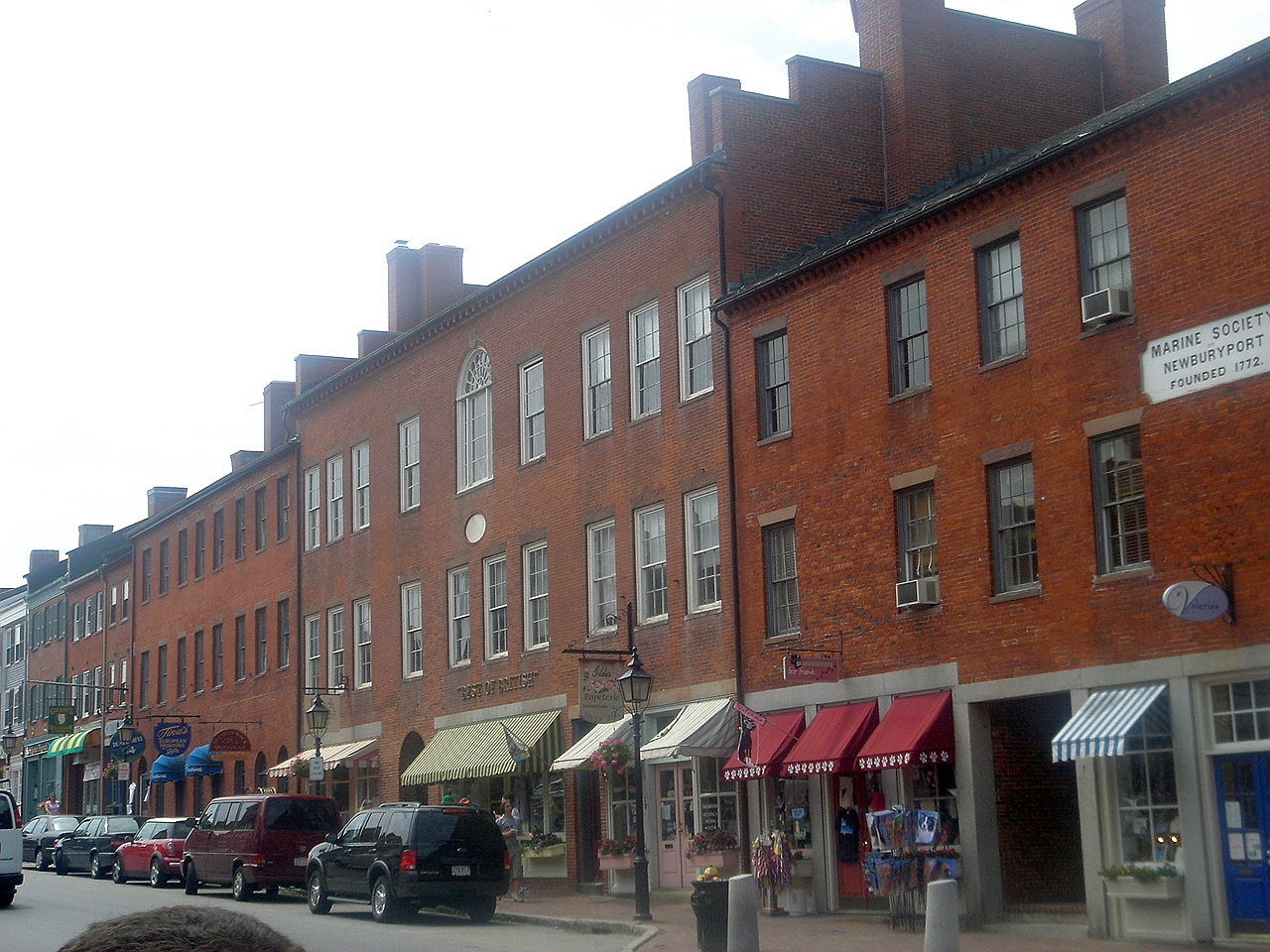
Newburyport is one of Massachusetts' most well-known and vibrant coastal communities. Located near the mouth of the Merrimack River and Plum Island, it has a long history of maritime trade, fishing and tourism, and is officially recognised as the founding place of the United States Coast Guard.
The Old Newbury Museum, housed in an elegant Federal-style mansion built in the early nineteenth century, is dedicated to preserving the history of Newburyport and its neighbouring communities. Among its many historical and unique artefacts, a large painted wooden statue of a man in military uniform stands out on the stairs, apparently following visitors with its gaze as they pass.
Timothy Dexter, born in colonial Massachusetts in 1747 to a poor family of English and Irish descent, was probably the owner who gave this work its peculiar character. Dexter left school around age eight to work as a farm labourer and at sixteen became a tanner's apprentice. In 1769, at twenty-one years old, he moved to Newburyport and married Elizabeth Frothingham, a thirty-two-year-old widow of considerable wealth. Using the fortune he acquired, he purchased a large mansion and began his extraordinary though prosperous business ventures.
After the American Revolution ended, Continental Dollars depreciated to the point of becoming practically worthless and could be easily acquired. Dexter bought enormous quantities of these dollars, and when the United States government decided to honour its debt, he made a considerable profit. He used the money to build two ships and start an export business to the Caribbean and Europe selling unusual items. He sold bed warmers, designed for the cold winters of New England, to the West Indies, a tropical climate. Though it seemed illogical, the local molasses industry reconditioned them as ladles. Dexter also sent a shipment of woollen gloves to the West Indies, which were purchased by Russian merchants docked in the port and subsequently resold in Siberia. He also exported a large number of stray cats to the Caribbean, which were bought by locals to control the rodent population, and accumulated a large quantity of baleen that was later used to make corset stays.
Dexter's unusual success and fortune made him the object of envy among New England's high society, whose members devised ways to ruin him. Some suggested that he "sell coals to Newcastle" in England, an idiom describing a futile or pointless action, since the city was one of the world's greatest coal producers in the eighteenth century. Dexter interpreted the suggestion literally and sent a large shipment of coal that was purchased at a premium price because local miners were on strike at that time. He was also convinced to sell trousers, gloves, leather and whale fat to the East Indies, which were purchased just in time by Portuguese merchants en route to China.
Despite being scorned and mocked by other members of society's elite, Dexter was proud of his particular style of business acumen and his ability to see value in items that others considered worthless. He used his immense wealth to decorate his home with minarets and a mausoleum for himself, and placed forty life-size sculptures of various famous men on its exterior, including George Washington, Thomas Jefferson, Napoleon Bonaparte, William Pitt the Elder and himself. On his own sculpture he had inscribed: "I am the first in the East, the first in the West, and the most learned philosopher in the Western world". He called himself "Lord Timothy Dexter" and offered money to people who would call him "Lord Chester" when he stayed at his property in Chester, New Hampshire.
Other eccentric aspects of his personality included telling people that his wife, who was alive, had died and that the woman in his home was her ghost, faking his own death and holding a mock funeral just to see how many people would attend, and sending repeated petitions to be appointed to public office. He received the title of "Informer of Deer", whose purpose was to notify people when there were deer in the city and enforce local deer hunting laws, despite no deer living in Newburyport. Towards the end of his life in 1802, he published a book titled "A Pickle for the Knowing Ones", in which he mainly complained about politicians, the clergy and his wife. The book is notable for its excessively poor grammar and spelling and for having no punctuation whatsoever.
After his death in 1806, his property and most of his belongings were auctioned off. The Great September Hurricane and the New England Hurricane of 1815 destroyed most of the outdoor sculptures, whilst the remaining ones were sold or salvaged for firewood. The only sculpture that survives today is that of William Pitt the Elder, which was once owned by the Smithsonian Institution and was restored before being returned to Newburyport, where it is displayed at the Old Newbury Museum.