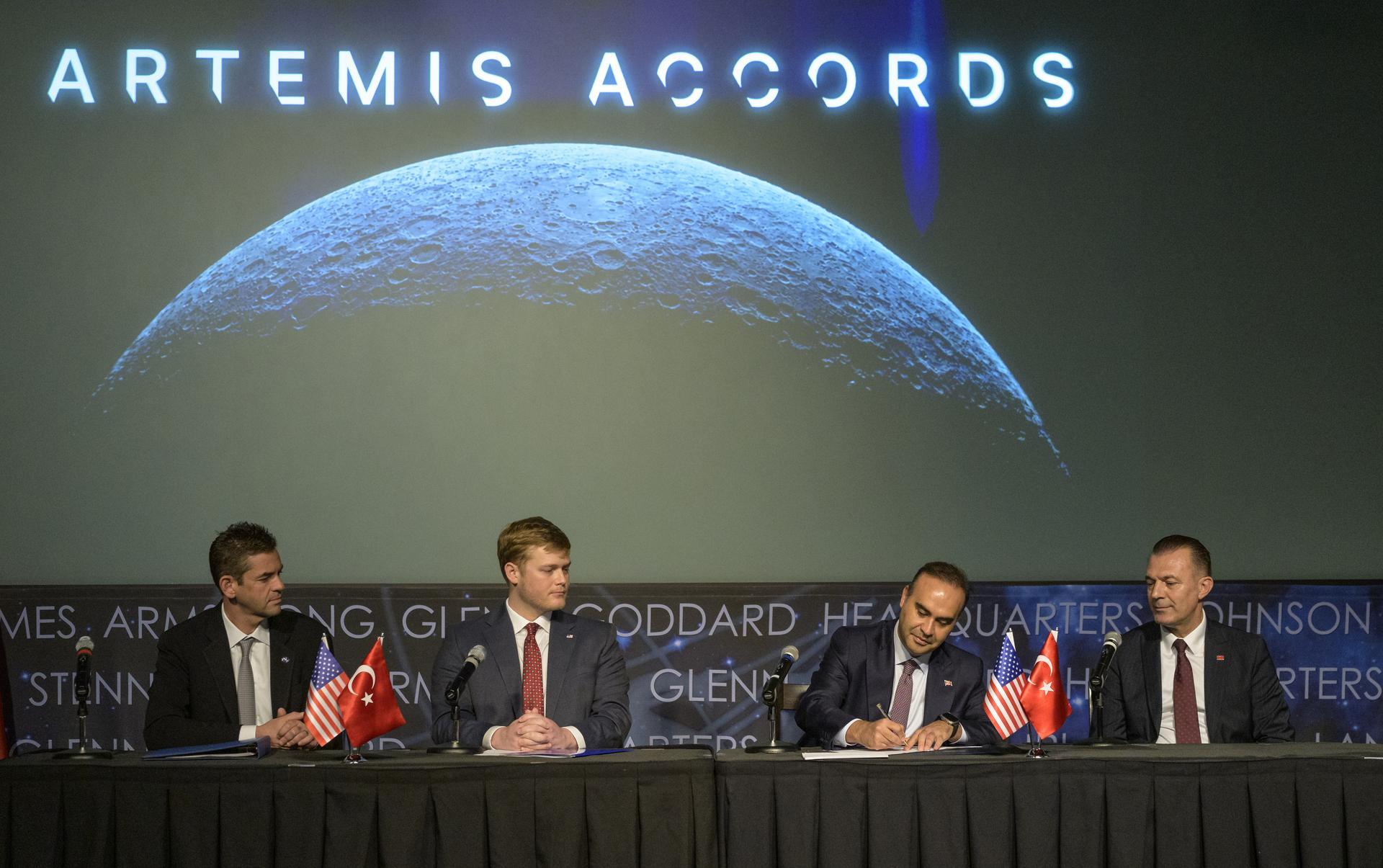
During a ceremony held by NASA Administrator Jared Isaacman at the agency's headquarters in Washington on Monday, the Republic of Turkey signed the Artemis Accords, joining the growing international coalition of nations with shared interests dedicated to peaceful and transparent space exploration.
"It is an honour to welcome the Republic of Turkey as the 71st signatory to the Artemis Accords," Isaacman said. "Last year, President Trump tasked NASA with accelerating its return to the lunar surface and establishing humanity's first sustained presence on another world, a Lunar Base, as well as laying the groundwork for crewed exploration of Mars".
"NASA never undertakes these great endeavours alone," Isaacman added. "At the Lunar Base we are bringing the principles of the Artemis Accords into practice on the lunar surface. NASA has invited each signatory to participate in this effort, creating opportunities for nations to contribute important pieces of hardware, scientific payloads, technology demonstrations, CubeSats and other capabilities to future Artemis missions".
Turkey's Minister of Industry and Technology, Mehmet Fatih Kacır, signed on behalf of Turkey. The President of the Turkish Space Agency, Yusuf Kıraç, and the Deputy Assistant to the U.S. State Department Adviser on Space and Environmental Affairs, Connor Tomlinson, also participated in the event.
Turkey's recent achievements in crewed spaceflight underscore its commitment to space exploration. In 2024, the country's first astronaut, Alper Gezervaci, travelled to the International Space Station on Axiom Mission 3 and conducted scientific research alongside NASA astronauts. That same year, a second Turkish astronaut, Tuva Atasever, flew on the Virgin Galactic 07 suborbital mission, performing experiments and physiology research.
Turkey will soon launch its first lunar mission, AYAP-1, joining the small but growing group of countries building and launching their own satellites to the Moon.
Turkey's signing also coincides with the country's preparations to host the International Astronautical Congress in Antalya this October. Dozens of Artemis Accords signatories are expected to attend to discuss the future of peaceful and transparent space exploration.
In 2020, NASA and the State Department joined with seven other founding nations to establish the Artemis Accords, responding to growing interest in lunar activities from both governments and private companies. They introduced the first set of practical principles designed to enhance safety and coordination among nations as they explore the Moon, Mars and beyond.