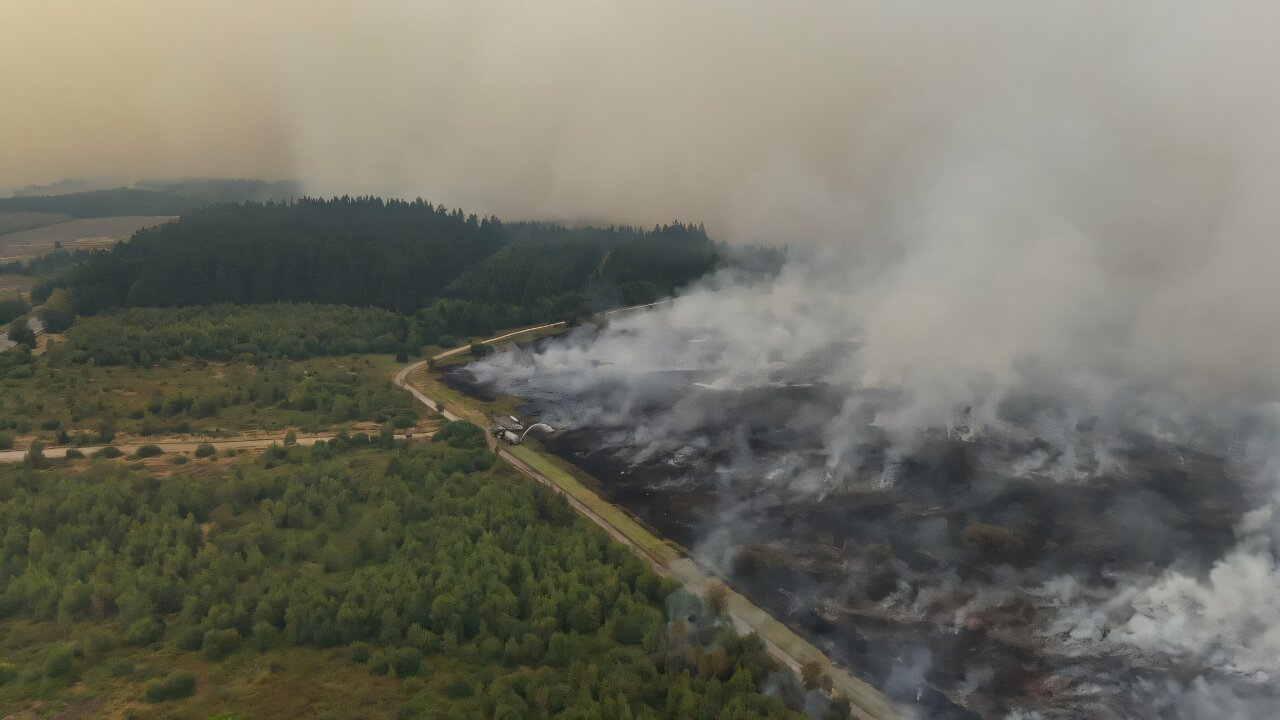
Water-dropping aircraft and farmers' tractors joined firefighters on Sunday in efforts to control Belgium's largest wildfire of the modern era, which has devastated vast stretches of a hard-to-reach nature reserve near the German border.
The fire has spread to 3,000 hectares (7,500 acres) two days after starting in the High Fens park, an area of boggy peatlands and pine forests popular with hikers. The head of the local fire service, Luc Burette, said that "if we cannot contain the fire", there is a risk it will spread to the German side of the border.
Gregory Melotte, one of several hundred firefighters and emergency workers deployed at the site, said that "we have really limited the damage to prevent it advancing into the large firs", though he clarified that the fire was still not "under control". Melotte was working his third shift in three days.
A vast area along the border has been covered by a dense column of yellowish smoke, which prompted the partial evacuation of two Belgian villages. Around 20 people spent the night in a local sports hall. The German city of Monschau also urged residents closest to the fire to evacuate, noting that the front was just 1.8 kilometres (1.1 miles) from the first inhabited areas.
Chinook helicopters loaded with water, brought from the Netherlands, led the efforts. Local farmers also came to help, with a "ballet" of tractors transporting tanks of water drawn from a nearby lake. Jean-Pierre Robert, manager of a hotel on the lake shore, said that "right now there are around 15 tractors waiting to fill their tanks".
Authorities described Sunday's conditions as still "challenging". However, Interior Minister Bernard Quintin stated that two of the fire fronts —heading towards the villages of Jalhay and Monschau— were now "under control".
The fire broke out for reasons still unknown in an area that was devastated by enormous fires in 1911, during a similar period of heat waves and drought, and is the country's largest wildfire since then. The smoke has reached the neighbouring Belgian province of Namur and even parts of eastern France, where the Moselle department activated an air pollution alert.
On the ground, changing winds have complicated firefighting efforts, but the office of the Liège governor stated that "the defensive line protecting the evacuated areas is holding". "No homes have been affected at this stage, although the fire remains close and smoke levels are significant", it added.
Firefighters from across Belgium and Germany have been deployed to the area, supported by state-of-the-art fire engines. However, authorities noted that operations were "particularly complex" due to the peatland terrain —a mosaic of heathland, peat marshes and elevated wooden walkways where heavy vehicles risk sinking and firefighters have difficulty fighting the fire nearby.
Two firefighting aircraft arrived on Sunday from Sweden and began working, supporting four helicopters —two Belgian and two Dutch— already present. A liaison officer was coordinating air resources "to prevent accidents", European Commissioner Hadja Lahbib told the AFP. Prime Minister Bart De Wever thanked Belgium's European partners for their assistance.
Like much of Europe, Belgium has experienced a new period of intense heat and drought in recent days. Temperatures reached up to 37°C (99°F) in some parts of the country on Friday, creating conditions conducive to wildfires. However, rescue teams have been unable to access the area where the High Fens fire started, meaning its precise cause remains unknown.