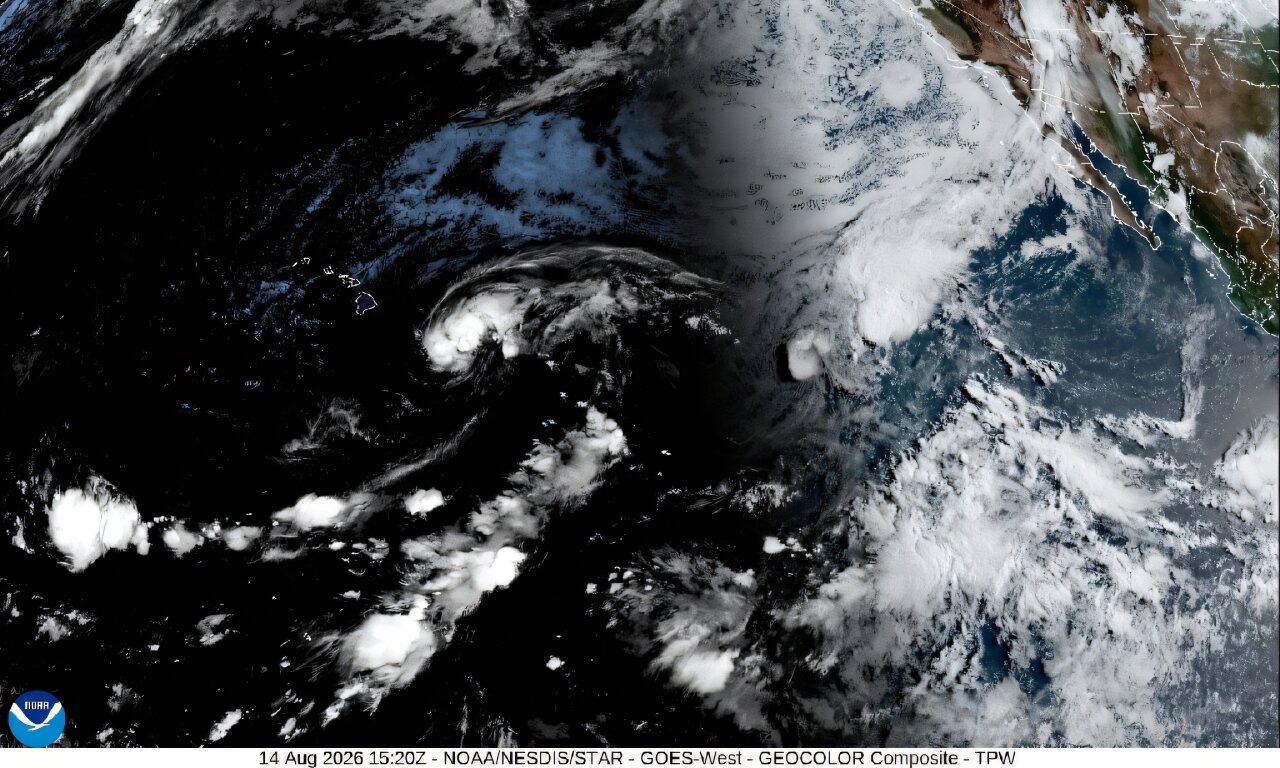
Hurricane Lala was moving away from Hawaii's Big Island in the early hours of Sunday as heavy rain and intense winds battered the Pacific state and officials warned of possible dangerous flooding.
"Destructive winds will persist over parts of Hawaii's Big Island overnight, with the strongest winds expected in higher terrain areas," the National Hurricane Center said at 11 p.m. local time (0900 GMT Sunday), warning that the coast would be battered by "large and dangerous waves". Lala strengthened into a Category 1 hurricane on Saturday, generating winds of up to 75 miles per hour (120 kilometres per hour).
Lala "apparently reached its peak intensity" as it passed near South Point on the Big Island in the afternoon and did not make landfall. "The hurricane could maintain its intensity for a few more hours, but weakening is expected from early Sunday as Lala continues to move away from the Big Island," said National Hurricane Center officials.
Besides the Big Island, a tropical storm warning was in effect for the state's other seven main islands: Maui, Molokai, Kahoolawe, Lanai, Oahu, Kauai and Niihau. Maximum total precipitation of 30 to 35 inches (76 to 89 centimetres) was expected over the leeward Big Island. "Heavy rainfall, with life-threatening flooding and landslides, especially in areas of steep terrain, will continue tonight through early Sunday over the Big Island and Maui," officials warned.
Heavy rain and flooding risk would spread westward across the island chain on Sunday, according to the National Hurricane Center. Power outages affecting more than 20,000 customers in Hawaii were reported on Saturday afternoon, with weather officials confirming that "destructive winds and heavy rain" were spreading across the Big Island, which is famous for surfing and tourism.
Surf generated by Lala would increase during the weekend and is likely to cause "life-threatening surf conditions and dangerous rip currents". "This is a serious storm," said Governor Josh Green, proclaiming a state of emergency to ensure that Hawaii and its counties "have sufficient resources to clear debris, secure infrastructure and take other measures to prepare".
Honolulu Mayor Rick Blangiardi said on Friday that his administration had spent days preparing for the storm and urged residents to be ready. The state was last hit by a "major" hurricane — that is, Category 3, 4 or 5 on the Saffir-Simpson scale — in 1992, when Hurricane Iniki caused at least six deaths and billions of dollars in damage.
Hawaii was threatened by Hurricane Fausto last month before the storm weakened and skirted the north of the island chain. The storm arrives as a powerful El Niño has formed in the central equatorial Pacific. Temperatures are already so high that the National Oceanic and Atmospheric Administration now predicts a 69% probability of a "historic event that would exceed the strength of El Niño events since 1950" when it peaks between October and December.
El Niño, a natural climate pattern in which sea surface temperatures in the central and eastern Pacific become unusually warm, tends to promote hurricane activity in the Pacific while suppressing it in the Atlantic. Human-caused climate change can amplify the impacts of El Niño because a warmer ocean and atmosphere increase the availability of energy and moisture for extreme weather events, such as heat waves and abundant rainfall.
Hawaii's emergency management agency recommended that residents clean gutters and drains, move valuables off the ground, seal cracks in doors and remove tree branches threatening their properties.