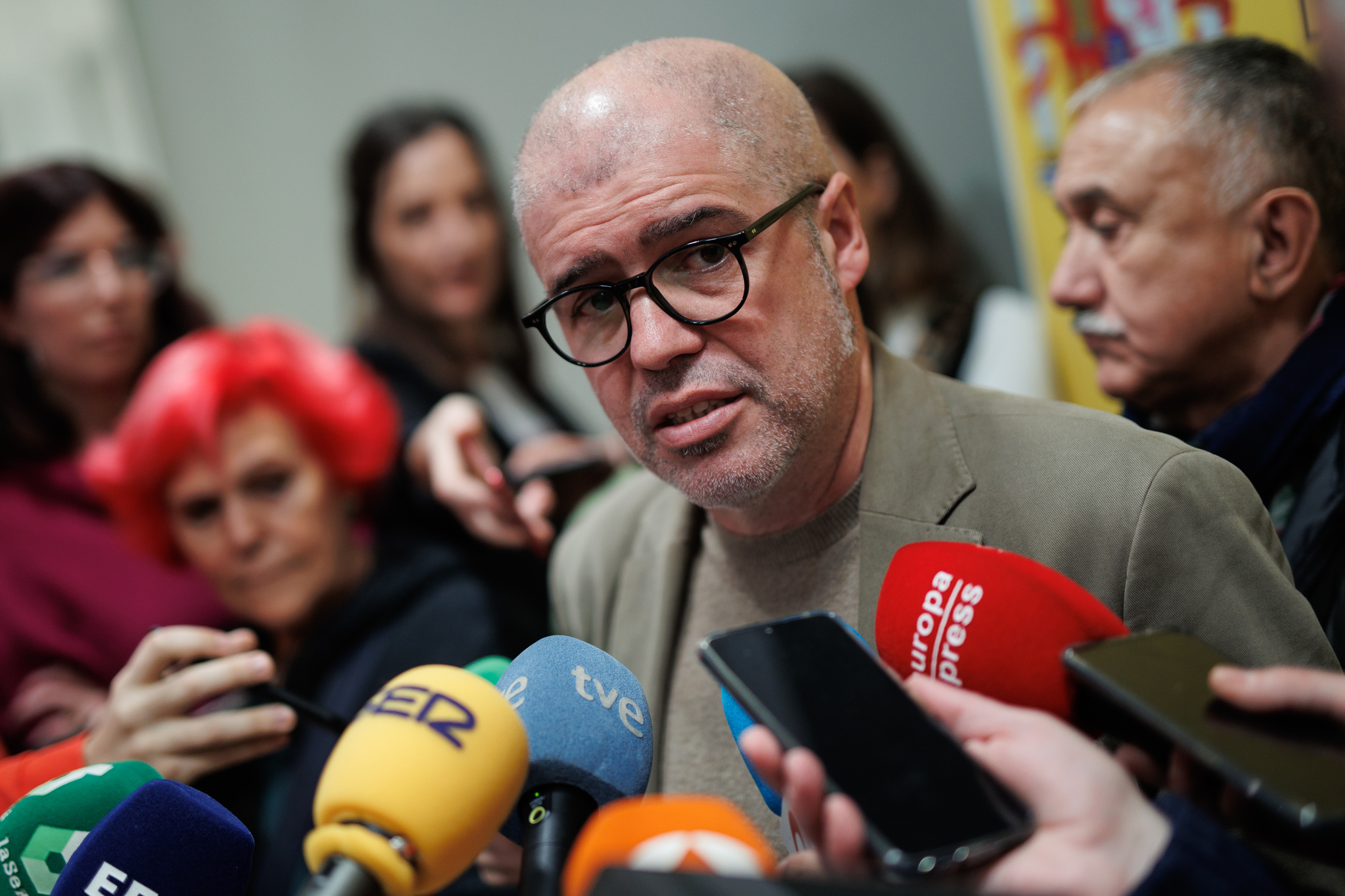
The general secretary of the Comisiones Obreras (CCOO), Unai Sordo, warned that the unions will not agree to "anything" with the Government in the coming weeks or months unless time-clock registration is approved. Sordo stated that although he can understand that agreements such as working-hour reductions may not advance due to the current parliamentary arithmetic, he considers it unacceptable that measures depending solely on the Government remain "stalled".
"Time-clock registration is a casus belli," Sordo declared in a radio interview. He pointed out that the unions will not continue to reach agreements that are then not reflected in official rules because this devalues social dialogue and the role of social agents. He insisted that they will not give "the benefit of the doubt" to agreements without the guarantee that they will become law.
Sordo indicated that he considers it "utopian" for the working-week reduction from 40 to 37.5 hours to be approved through legislative channels in the current parliamentary term. However, he stated that the unions will fight for 37.5 hours in the negotiation of collective bargaining agreements this year and next, together with wage increases. He explained that the actual ordinary working day in Spain is 38.3 hours on average, although many sectors, especially the most precarious and female-dominated ones, maintain working weeks of practically 40 hours.
Sordo also criticised the stance of Spain's employers' federation CEOE in labour negotiations, stating that he senses a possible shift in the political cycle that would produce laws "far more hostile to workers". He pointed out that this makes it difficult to reach tripartite agreements because the CEOE has one eye on the negotiating table and another on the expectation of that political shift.
Regarding the discourse on sick leave, Sordo rejected the statements of the Popular Party leader, Alberto Núñez Feijóo, who had stated that a worker on sick leave cannot earn the same as an active one. The union leader clarified that in Spain people do not earn the same on sick leave as when working except if the employer agrees to it. He argued that the solution to reducing sick leave involves investing in health prevention, not tightening measures against workers.