Curiosity rover operations on Mars this week resumed the "regularly scheduled programme" following a brief detour to investigate an "erosional surface". The team returned to the planned course to ascend Mount Sharp. As the season transitions towards autumn in Gale Crater, temperatures and the likelihood of dust storms begin to decrease, although Curiosity continues to monitor the last remnants of local and regional late-season dust storms.
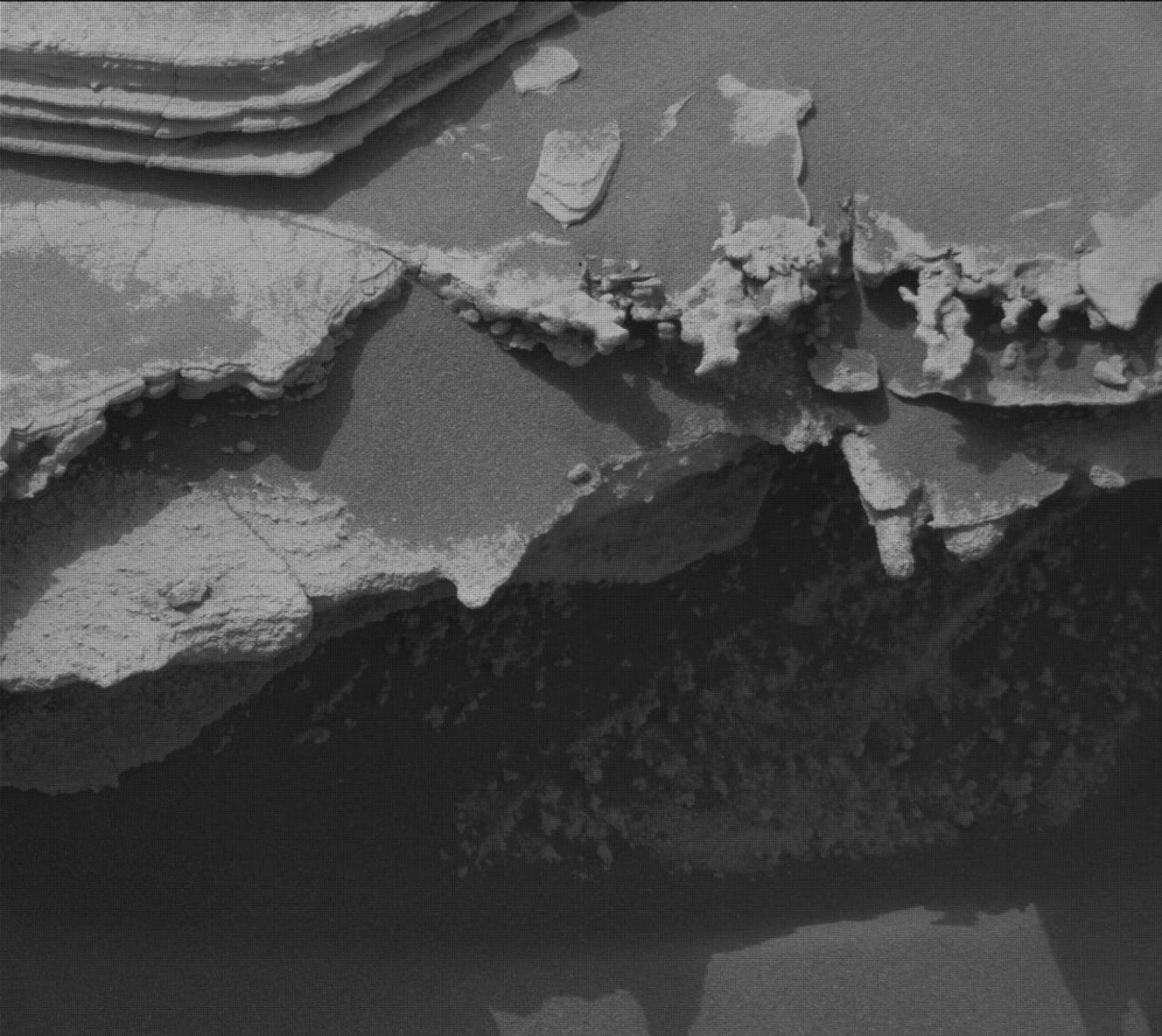
The plan for sols 4982 to 4985 began with Curiosity facing a unique geological feature just above the contact of the supersurface erosional. The team took advantage of two planning cycles at this notable location. MAHLI reacquired selected images for the "Tres Morros" target mosaic, providing the scientific team with a detailed view of the underside of this feature. APXS performed measurements on the "El Motacusal" bedrock target after being brushed with the DRT, and took a second measurement on the "as is" bedrock target called "Alto de Carmen". Both APXS targets were documented with high-resolution images taken by MAHLI. ChemCam activities included LIBS spectroscopy on the "Lagunas Bravas" and "Parququcha" bedrock targets and remote microscale imaging on Mishe Mokwa. Mastcam captured a near-field mosaic of the erosional ridge called "Los Toldos", as well as a more distant bedrock exposure mosaic above the erosional surface, named "Los Ladrillos".
Curiosity then advanced 30 metres to reach the planning location for sols 4985 to 4987. Although there was abundant exposed bedrock at this new location, the team was unable to position the robotic arm in a safe position to brush the bedrock. The left front wheel was resting on a small rock, which presented risks if the rover slipped while the arm moved. MAHLI and APXS were able to perform safe contact science on two bedrock targets, "Mamorecillo" and "Aguas Claras". ChemCam used its laser spectrometry to gather geochemical data on three nearby targets, followed by Mastcam documentation. ChemCam's LIBS targets include a resistant dark-toned layer on the "Yura Kasa" bedrock.
The plan included numerous environmental monitoring activities to watch for dust storms. Mastcam performed multiple dust image observations to measure the optical depth or "tau" of the atmosphere, where higher tau values are associated with greater amounts of dust. APXS executed a night-time atmospheric measurement, whilst Navcam performed much of the work to monitor dust storms, including multiple dust devil surveys, zenith observations and above-horizon cloud movies.
Curiosity will continue ascending Mount Sharp with a planned driving distance of 47 metres that will take the rover southwest of its current location. The team will return on Monday to begin a new week of contact science, remote sensing and driving on Mars.