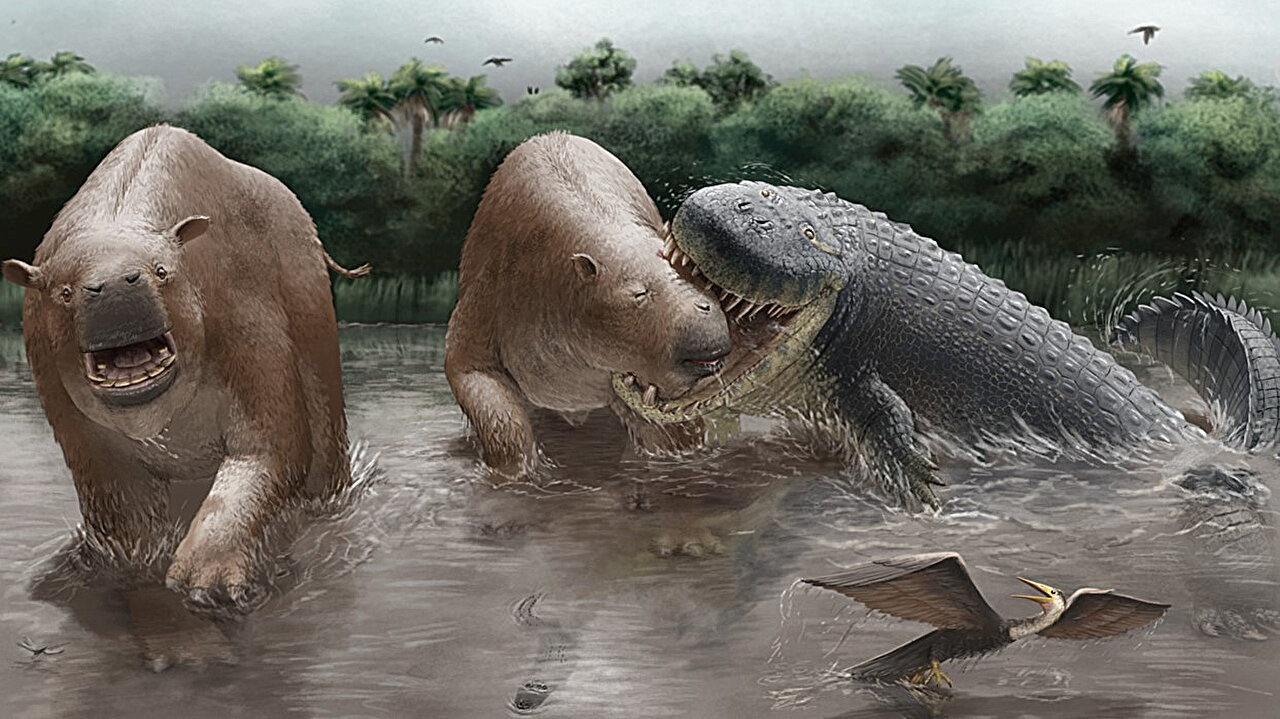
South America was a terrifying place during the Miocene. More than 10 million years ago, a vast lake covered much of the continent, home to giant turtles and crocodiles. A wide variety of predators hunted along the lake shores, including anacondas, sabre-toothed mammals, flightless "terror birds" and sebecids, terrestrial relatives of crocodiles.
A recent study shows that crocodiles were, in fact, the most significant group of predators in this habitat. "There was so much prey available that mammalian predators could not have eaten it all," said Oscar Wilson, a postdoctoral researcher at the University of Helsinki. "Our new study shows that crocodiles in particular were the most important predators in the region, especially when it came to hunting large prey," he added.
A wide variety of herbivores lived along the lake shores: giant ground sloths, glyptodonts—relatives of armadillos—and various groups of ungulates, such as astrapotheres ("thunder beasts") and toxodonts. The ungulates of this era could weigh more than one tonne. However, the predators were also giants. The largest predator of the time was a 7-metre-long crocodile weighing 1,800 kilogrammes, Purussaurus neivensis, a relative of modern caimans. At the top of the food chain, it may have even influenced the size of herbivore populations, the new study suggests.
The research is based on an analysis of fossils preserved in museum collections. Bite marks and teeth left by predators on herbivore fossils are the only direct evidence of interactions between species. The fossils examined were between 10.5 million and 16 million years old. "The frequency of bite marks probably made by Purussaurus suggests it was an important predator in these tropical ecosystems," Wilson said.