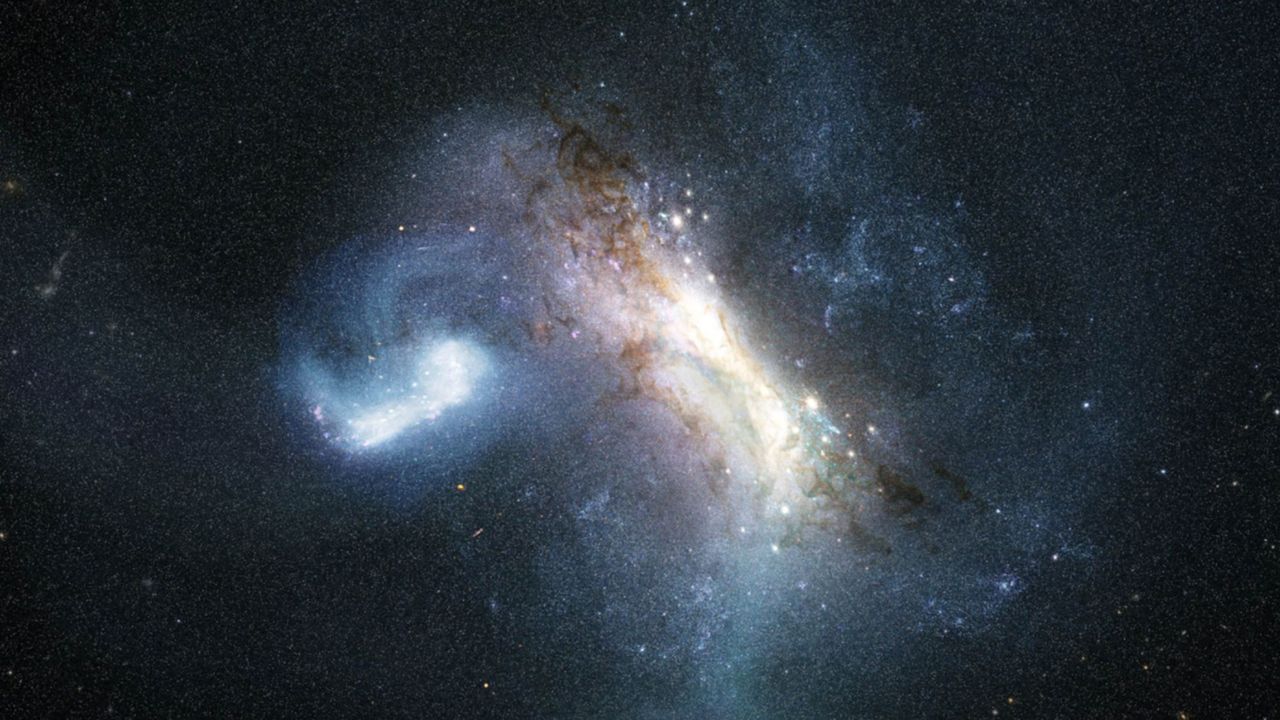
The Hubble Space Telescope has discovered evidence that our galaxy experienced a significant collision and merged with a dwarf galaxy 11.8 billion years ago. Mergers between galaxies constitute one of the main ways galaxies can grow, although while mergers can be observed in other galaxies, deciphering the history of the Milky Way requires meticulous research work.
"Our home is the Milky Way galaxy, but we don't know how our house was built," said Davide Massari of the Astrophysics and Space Science Observatory of Bologna in Italy in a statement. Massari is the lead author of a paper describing the discovery of an ancient galactic merger. "In this paper we discover where the first significant bricks came from: from a dwarf galaxy we call LKH".
LKH stands for Low-energy–Kraken–Heracles, a reference to three previous research papers linked to the idea of mergers in the early stages of our galaxy's history. In recent years, another significant merger has come to light: a collision with a galaxy called Gaia–Sausage–Enceladus (GSE) approximately 10 billion years ago. Massari's team has discovered a third population of globular clusters that appear to be neither native to the Milky Way nor part of the GSE galaxy, but rather seem to have arrived 11.8 billion years ago, before the merger with GSE.
"Thanks to Hubble's high resolution and depth of imaging, we were able to measure the age and metallic content of these clusters with unprecedented precision," said astronomer Chiara Zerbinati of the University of Bologna, co-author of the paper. In the language of astronomers, metals are elements heavier than hydrogen and helium formed in the Big Bang, and include elements such as oxygen, carbon, iron and aluminium. Based on the number and mass of the imported globular clusters, the team calculated that LKH had a total mass of 500 million times the mass of our sun, only slightly more massive than the Sagittarius Dwarf galaxy, which the Milky Way is currently consuming.
The discovery of the merger adds an important new event to the history of the Milky Way, one that undoubtedly would have influenced the evolution of our galaxy. For example, the collision could have triggered a fresh burst of star formation, helping the Milky Way to grow, while the chemistry of LKH's stars would have impacted the overall chemical evolution of the Milky Way. The discovery of the merger with LKH was reported on 17 August in the journal Nature Astronomy.