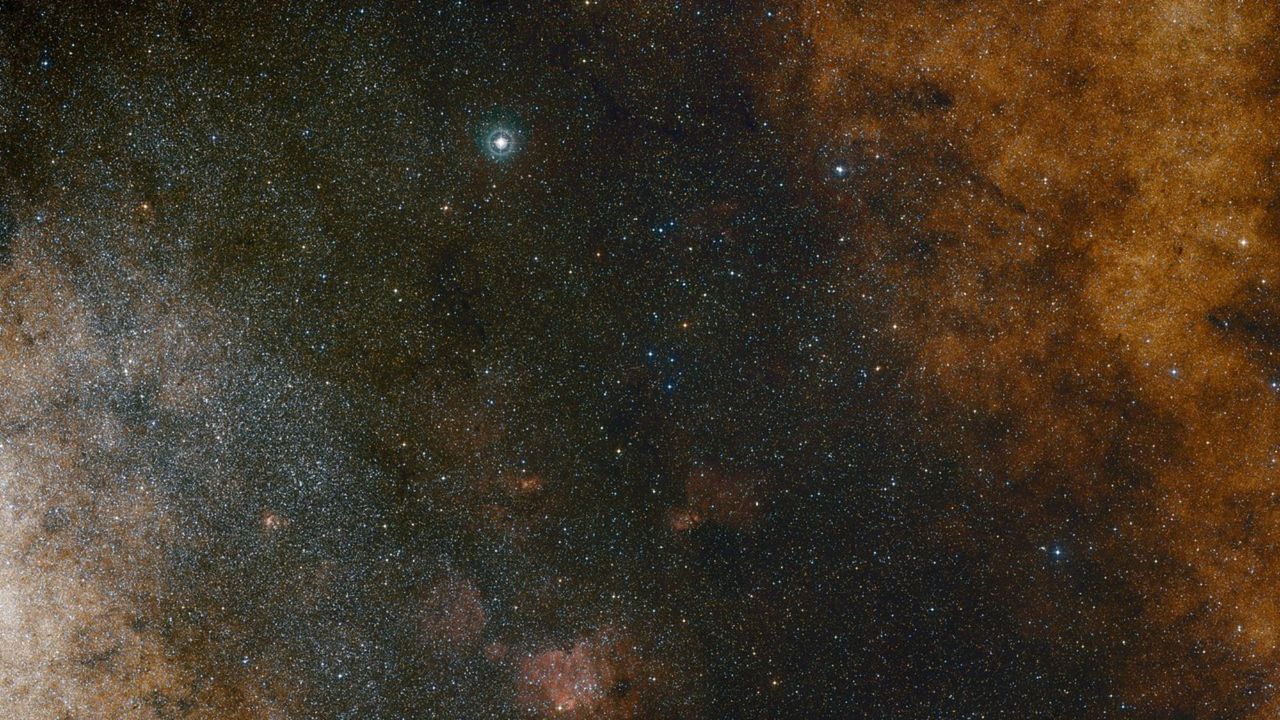
Astronomers have discovered the fastest known star in the Milky Way, a faint object that orbits Sagittarius A*, the supermassive black hole located at the heart of our galaxy. Named S301, the star reaches approximately 15,500 miles (25,000 kilometres) per second at its maximum velocity, which represents more than 8% of the speed of light.
"What makes this star special is that it orbits Sagittarius A* in a very tight orbit, completing its path in just 8.7 years, and approaches the black hole at only 12 times the distance from the Earth to the Sun. This is unprecedented," said Felix Mang, a doctoral student at the Max Planck Institute for Extraterrestrial Physics in Germany and co-author of the study, in a statement.
The discovery provides astronomers with a new way to investigate the black hole of approximately 4.3 million solar masses. General relativity predicts that a rotating black hole drags spacetime with it, an effect known as frame-dragging or Lense-Thirring precession. This distortion should gradually alter the orbit of S301. Since the star ventures so close to Sagittarius A*, these changes could become measurable in approximately one decade.
"For the first time, we could measure very directly the spin of a massive black hole, which would be a key test of Einstein's theory," said Stefan Gillessen, co-author of the study, also from the Max Planck Institute.
Researchers identified S301 in 2023 using the GRAVITY instrument on the Very Large Telescope Interferometer of the European Southern Observatory in Chile, and then tracked its movement in observations from 2021 and 2017. Its highly elongated orbit suggests that S301 may once have belonged to a binary system that came too close to Sagittarius A*. The black hole could have captured S301 while ejecting its companion at a tremendously high velocity.
Astronomers plan to continue tracking S301 with GRAVITY+ and eventually with the ESO's Extremely Large Telescope. With its next closest approach expected in 2031, observations spanning two complete orbits could reveal the spin of Sagittarius A* for the first time. The team's results were published on 19 August in Nature.