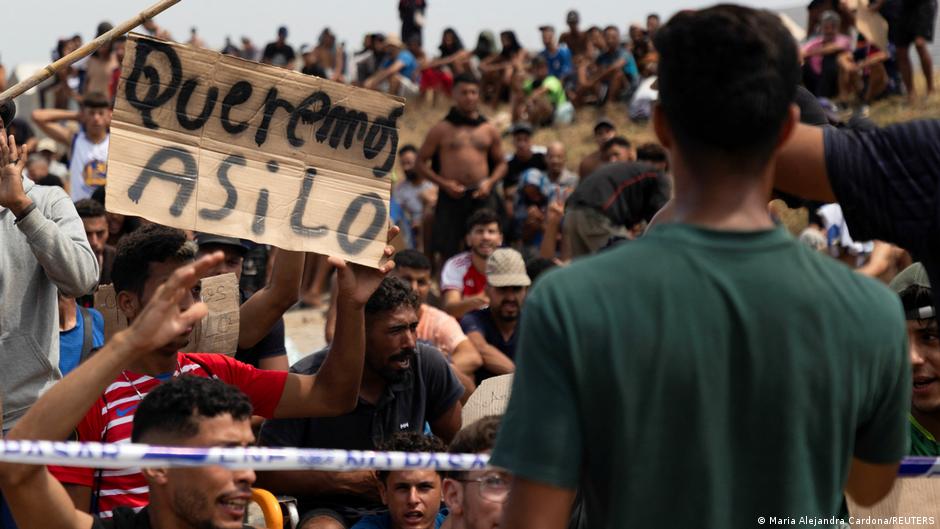
Hundreds of migrants who recently entered the Spanish enclave of Ceuta in North Africa protested on Sunday 16 August on a famous beach, demanding that Spanish authorities grant them asylum instead of returning them to Morocco.
The demonstrators were part of between 5,000 and 8,000 migrants remaining in Ceuta following a mass border crossing two weeks earlier in which more than 72,000 people arrived at this small enclave of approximately 80,000 inhabitants. The vast majority returned voluntarily in the days that followed.
Due to the depletion of municipal resources, most migrants are living in precarious conditions on El Trampolín beach or on the outskirts of the city, waiting for the opportunity to travel to mainland Europe. Ayoub El Aroud, a resident of Tétouan, stated: "We sleep by the sea, in the cold and with unpleasant smells. We suffer greatly". He added that police prevent migrants from accessing the city centre.
The demonstrators carried Spanish flags and placards with messages such as "We do not want to return to Morocco" and "We are human beings too", while chanting slogans such as "We have had enough" and "We need a solution".
Spanish Interior Minister Fernando Grande Marlaska stated last week that migrants who entered illegally will not be permitted to remain in Ceuta, travel to mainland Spain or obtain legal status, except in exceptional cases related to serious risk.
Enrique Rubiralta, president of the Ceuta medical college, told radio station Onda Cero that the limited staff in the local health sector are exhausted and criticised what he described as the "slow response" from the central government. Rubiralta indicated that diseases such as diarrhoea and scabies have begun to spread, and that injuries related to violence, such as fractured noses or knife wounds, are increasing.
Health Minister Mónica García rejected today accusations of a "collapse" in local health services, but acknowledged they are facing pressure. She told journalists in Ceuta that "linking migration with disease is unfair and reflects xenophobia", adding that the risk of epidemic spread among migrants is moderate and remains low for the city's population.