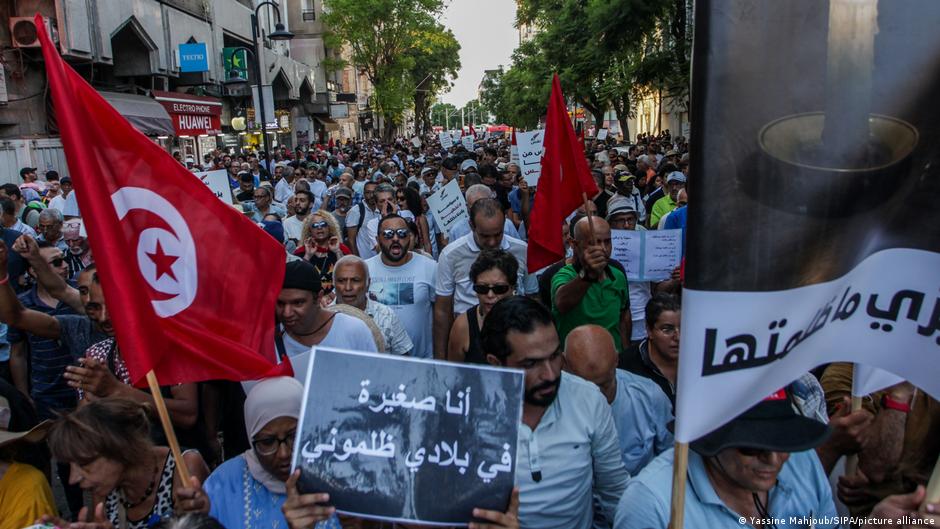
More than a thousand people protested on Thursday in Tunisia against restrictions on freedoms, detentions they described as "arbitrary", economic policies they characterised as "poverty-inducing" and social cuts that protesters said are being imposed by President Kais Said's government, which has been in power since 2019.
The NGO Nafas organised the protest, during which participants called for the "urgent end" of Said's mandate and urged "all" the Tunisian people to join the struggle "to overthrow the president and restore democracy" which they believe "has disappeared". Demonstrators carried placards reading "Tunisia is a republic, not a monarchy, and we are citizens, not subjects", "End injustice" and "He has destroyed purchasing power", among other slogans.
Participants demanded "fair" elections to "recover freedom and the separation of powers". National and international organisations have denounced a serious democratic backslide since July 2021, when Said assumed full powers to, according to the president, "set right" the course of the democratic transition.
Restrictions on movement and the detention of activists have drastically reduced the number of protests and participants in recent years, with regular attendance of barely five hundred people. However, on 25 July, nearly three thousand Tunisians took to the streets on Republic Day to demand "the definitive and inevitable end of seven years of poverty, unemployment, marginalisation, repression and populism under the regime".
According to various organisations, that date "marked the beginning of an unstoppable wave of protests leading to the fall of the government". Tunisia began a democratic transition with the Arab Spring which, according to civil society, was interrupted when Said assumed full powers and changed the political and constitutional system before winning re-election in the October 2024 presidential poll.