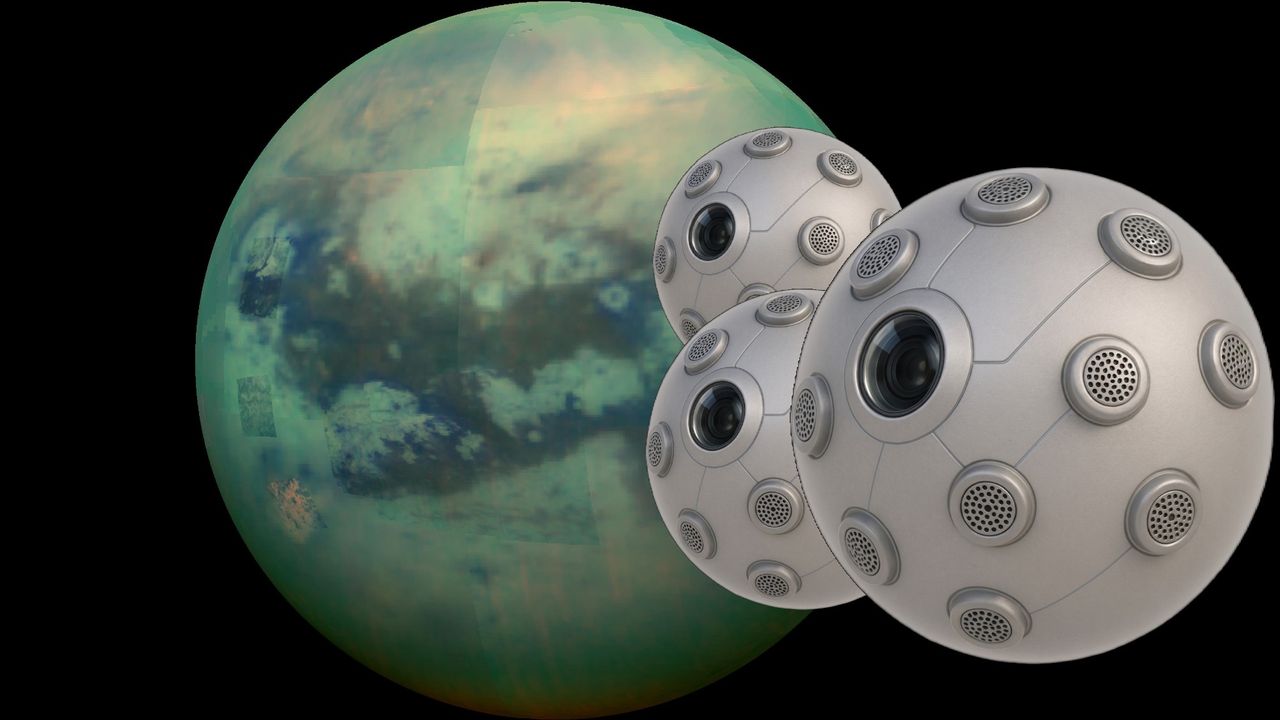
Small spherical "Aerobots" could one day explore caves on Titan, a moon of Saturn that NASA describes as one of the worlds most similar to Earth in the solar system. Titan is covered with rivers, lakes and seas of hydrocarbons such as methane and ethane, as well as a strange "karst" terrain with sinkholes and underground caves. No conventional rover could easily traverse this surface, but flying vehicles could have greater success.
A new grant from NASA's early-stage Innovative Advanced Concepts (NIAC) programme aims to create small flying vehicles to explore those caves. The aerobots, called SPARK for Solid-state Propulsion for Autonomous Reconnaissance of Karst, are in an initial nine-month phase, indicated Daniel Drew, assistant professor at the University of Hawaii at Mānoa. It is unclear whether they would be ready in time for NASA's Dragonfly mission to Titan, scheduled to launch in 2028, though a mission delay could open possibilities for late additions.
Drew noted that his design could "provide persistence, manoeuvrability and robustness in the face of challenging cryogenic conditions, minimising disturbances that affect scientifically important layers of hydrocarbons". He expressed hope that SPARK could be a precursor to cave exploration on Titan similar to the Ingenuity helicopter on Mars, which completed 72 flights, far exceeding what was originally planned.
Drew has worked on electrohydrodynamic-type ion thrusters since his postgraduate studies at the University of California, Berkeley. With the new NIAC funding, Drew and his collaborators—including Ethan Schaler and Jacob Izraelevitz of NASA's Jet Propulsion Laboratory, and Michael Malaska of the Blue Marble Space Institute of Science—plan to rapidly design experiments and model aspects such as thermal effects on the power system. Drew noted that the idea of "standing on the shoulders of giants" is deeply rooted in NIAC culture and that their primary contribution will be a comprehensive public report.