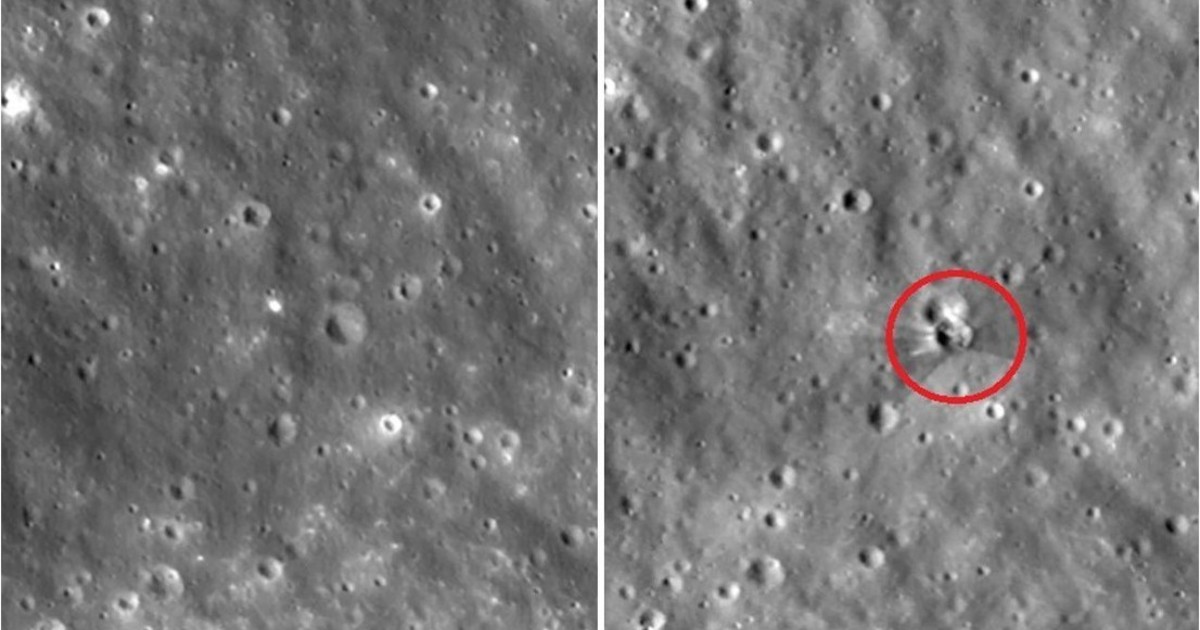
NASA's Lunar Reconnaissance Orbiter is providing the clearest images of the crater left by the impact of a SpaceX Falcon rocket's upper stage. The space agency released photographs showing the impact zone before and after the collision.
The Falcon's upper stage crashed into the Moon at 8,700 kilometres per hour on 5 August, after having orbited in space for more than a year. The rocket had launched in 2025 a pair of private lunar landers equipped with experiments and even a small rover, as part of NASA's plan to commercialise lunar exploration.
According to scientists, the new crater measures approximately 18 metres across and less than 3 metres deep. Dark and bright streaks are clearly visible projecting from the crater like butterfly wings. The darker lines represent material excavated from near the surface that was shaped by solar wind, cosmic rays and micrometeorite impacts over millennia, whilst the brighter rays indicate rocks and fresh soil ejected from greater depth.
The orbiter captured the crater one week after the collision from a height of 96 kilometres whilst travelling at 1.6 kilometres per second. Flight controllers had to tilt the spacecraft so its cameras could focus on the impact scene. The probe completes a lunar polar orbit every two hours as the Moon rotates beneath it, and six days passed before the crash site became visible.
South Korea's Danuri spacecraft was the first to reach the impact site and transmit photographs.