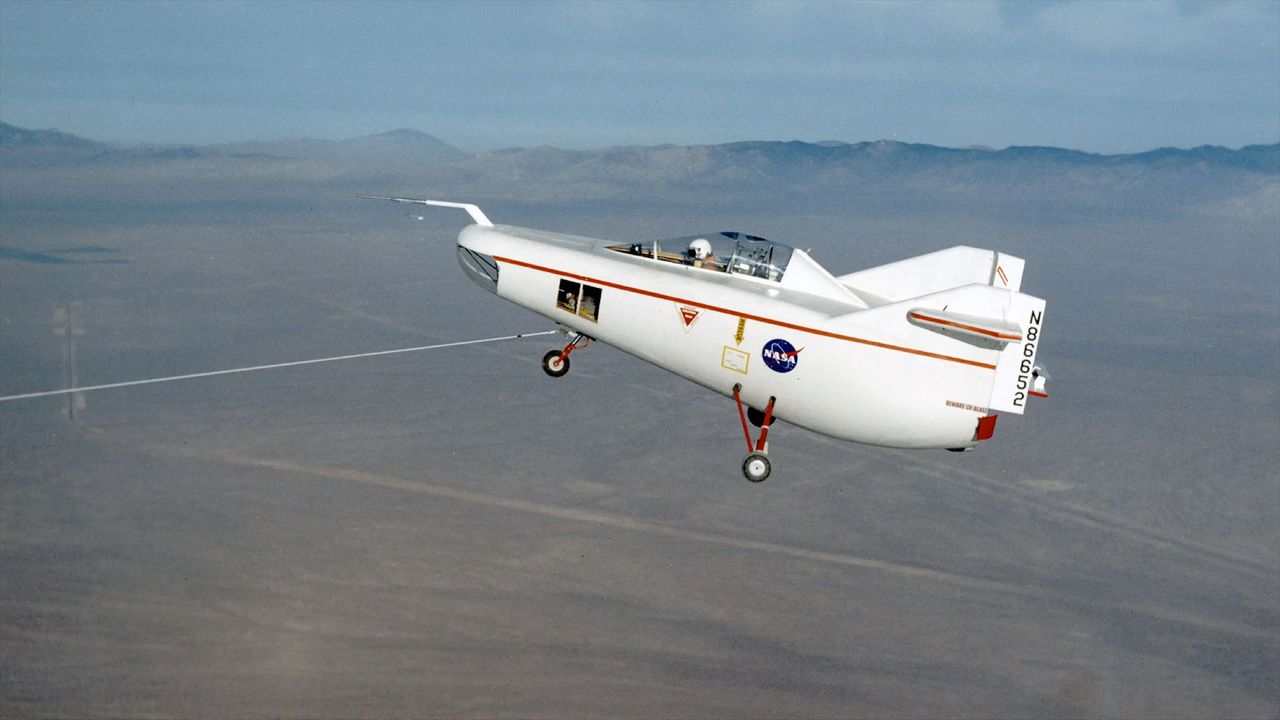
On August 16, 1963, NASA's M2-F1 aircraft prototype conducted its first glide flight. The wingless aircraft, which resembled a flying bathtub, was designed to test a new concept called a lifting body: a motorless glider that offered an alternative way to return crewed spacecraft to Earth.
Rather than having spacecraft fall from the sky in a ballistic reentry, the lifting body would land in a manner similar to a conventional aeroplane. For the first test flight, the M2-F1 was towed to 5,200 feet by a C-47 Skytrain and then released. Test pilot Milt Thompson flew the aircraft and made a smooth landing in California after a two-minute descent.
The success of the M2-F1's first glide flight demonstrated that a wingless lifting-body aircraft could be controlled and landed safely. The introduction of a second potential method for returning astronauts from space was a crucial consideration during an era when NASA was competing against the Soviet Union for access to space and, ultimately, to the Moon.
Although NASA opted for the familiar capsule and heat-shield design used in the Mercury, Gemini and Apollo programmes, the M2-F1 and its subsequent tests paved the way for NASA's continued research into lifting bodies, leading to the development of a complete family of test vehicles such as the M2-F2, M2-F3, HL-10 and the United States Air Force's X-24A and X-24B models, which conducted lifting-body flights at much higher speeds and altitudes.
Ultimately, data from these programmes was applied to the development of the Space Shuttle and to the actual practice of landing a spacecraft on Earth in the same manner as an aeroplane.