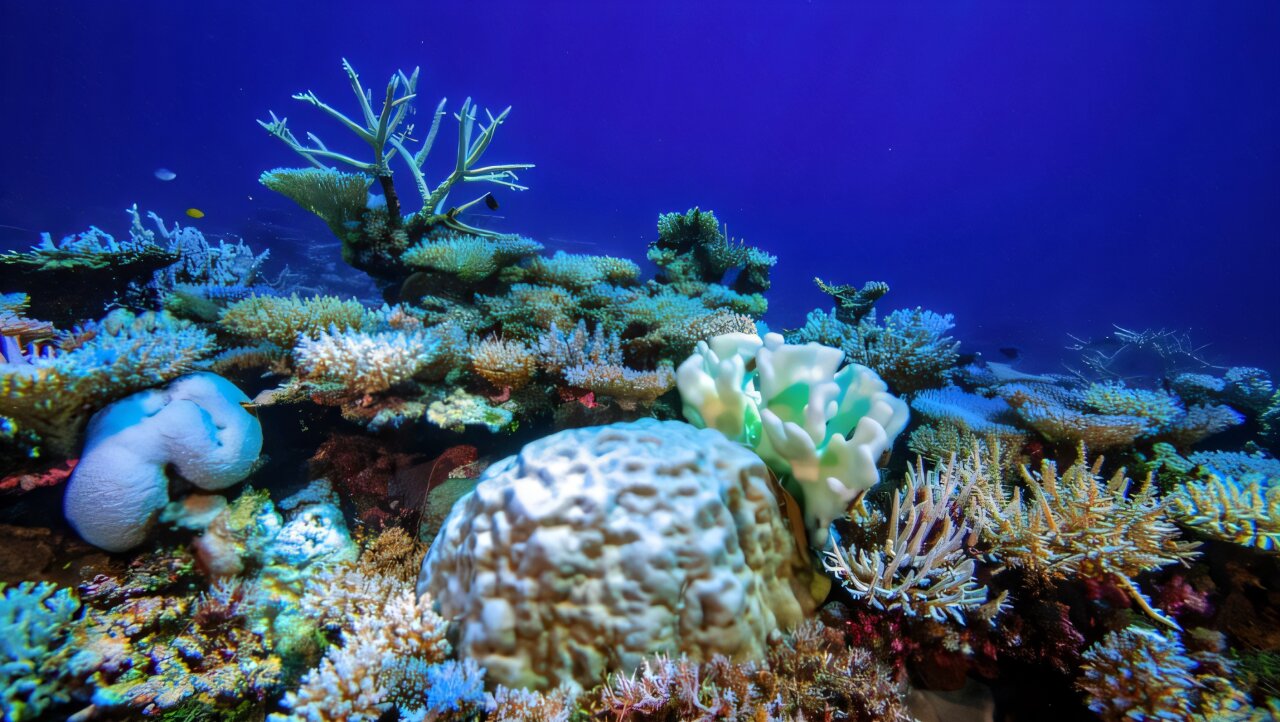
Australian coral reefs are in relatively good condition compared with coral reefs globally, although coral cover on Australian reefs has declined over the past 40 years, reflecting the global trend, according to a major new report released today.
The 2025 State of the World's Coral Reefs report, launched by the Global Coral Reef Monitoring Network (GCRMN), finds that the average hard coral cover measured globally in 2020–24 shows a decline of 9.5% compared with the baseline period 1980–2009. The report, the seventh from the GCRMN, is the largest and most comprehensive assessment of global coral reef health, covering 10 geographic regions, of which four experienced declines in coral cover.
Heat stress driven by climate change has become an increasingly important factor in coral loss in Australia and globally over the past decade. Dr Manuel Gonzalez Rivero of AIMS, global coordinator of the GCRMN, said that despite the overall decline, monitoring data also showed that recovery remained possible. "Globally, there was a relative 6% increase in hard coral cover between 2017 and 2019 after the third Global Coral Bleaching Event, demonstrating that reefs still have the capacity to recover, at least partially," he noted. "However, this recovery has been reversed by unprecedented losses from the recent fourth Global Coral Bleaching Event".
The report does not include a full assessment of the impacts of the fourth Global Coral Bleaching Event, which includes the mass bleaching events of 2024 and 2025 in Australian waters that caused significant declines in coral cover on the Great Barrier Reef and Western Australian coral reefs. Gonzalez Rivero said that large-scale disturbances previously occurred on coral reefs once every 10 years. Now, with more frequent Global Bleaching Events, they are occurring every five to six years, reducing the time reefs have to recover. "Our modelling suggests that if the current rate of Global Bleaching Events continues, the long-term decline in global hard coral cover will continue," he said, adding that "more ambitious reductions in global greenhouse gas emissions offer a more positive future for reefs, when combined with effective management of local pressures".
The report finds that average coral cover on Australian reefs has fallen from 30.2% in the baseline period 1980–2009 to 26.8% in 2020–24, a relative decline of 10.9%. Dr Mike Emslie, one of the lead authors of the Australian chapter of the GCRMN report and who leads AIMS' Long-term Monitoring Program on the Great Barrier Reef, said the assessment shows that Australian coral reefs have relatively good coral cover and have largely demonstrated the capacity to recover from disturbances such as coral bleaching driven by climate change, cyclones and crown-of-thorns starfish outbreaks if given sufficient time. "But the condition of Australian coral reefs varies considerably across the country. Some areas, such as Scott Reef off the northwest shelf, have been documented recovering after disturbances such as the 2016 mass bleaching event. Others, such as some reefs on the southern Great Barrier Reef and the Pilbara region of Western Australia, have experienced greater recent declines due to a series of disturbances," he said.
Despite these differences in Australia, a net loss of coral cover has still been recorded over this extended timeframe. What is not included in this report are additional losses from recent mass bleaching events on the Great Barrier Reef and Western Australia in 2024 and 2025. "Coral reefs are receiving less time to recover between disturbance events and are sometimes being hit by multiple stressors in short timeframes," Emslie added.
Dr Emma Kennedy, co-author of the GCRMN report and coral scientist at AIMS, added that it is uncertain whether historical patterns of recovery after disturbance could continue under an increasingly warm climate. "More frequent and widespread marine heatwave events leading to mass coral bleaching events are shortening intervals between disturbances and reducing the time available for reefs to recover," she said. "Historically, cyclones and crown-of-thorns starfish outbreaks were major causes of decline, particularly on the Great Barrier Reef, but mass bleaching has become increasingly prominent over the past decade".
AIMS monitoring of the Great Barrier Reef has shown a trend of volatility emerging over the past 15 years, with coral cover fluctuating between very low and very high levels, a change from the more stable patterns observed previously. Australian coral reefs span at least 43,000 km² of coral reef area, equivalent to approximately two-thirds the area of Tasmania, giving it the largest extent of coral reef of any nation. Australia is also home to three coral reef World Heritage Areas (the Great Barrier Reef, Ningaloo Coast and Lord Howe Islands group), and its reefs hold cultural significance for Australia's First Nations peoples. Approximately 2 million Australians benefit from healthy reefs through tourism, recreational and commercial fishing, science and management.
Dr James Gilmour, co-author of the report and coral scientist at AIMS, said Australia is one of the best-monitored coral reef regions in the world, although monitoring remains uneven. "Long-term data from areas such as the Great Barrier Reef are excellent, but there are still gaps in our knowledge of Australian reefs, particularly in our northern and northwestern areas, where remoteness, turbid waters and safety issues limit monitoring efforts," he said. "Expanding monitoring coverage will improve our ability to understand Australia's diverse reef systems and support effective management as climate pressures intensify. To help coral reef systems survive climate change, we must reduce emissions, manage coastal development, pollution and fishing pressure, while also developing interventions that help coral reefs adapt to and recover from disturbances".